
Response of The Esop Centre to the HM Treasury Call for Evidence on Non-Discretionary Tax Advantaged Share Schemes

What follows supplements the evidence and points made in a meeting with officials on 12th July 2023.

1. If you are a business owner or manager, what is your business activity, when was your company created, where is it based and how many employees do you have?

[Not applicable]

2. If you are responding on behalf of a representative body or think tank, please briefly describe the body, its objectives, and its members.

The Employee Share Ownership (Esop) Centre is a non-profit subscription-based organisation which draws from over 35 years of experience to inform, research and promote direct employee share ownership in the interest of developing all forms of broad-based employee share ownership plans in the UK and Europe. Its membership includes accountants, administrators, bankers, brokers, consultants, lawyers, registrars, remuneration advisers, and trustees, alongside the companies that issue share plans to their employees.

3. Does your company offer an employee share scheme? If so, which one?

[Not applicable]

4. To what extent do you agree/disagree that SAYE and SIP are fulfilling their policy objectives?

Both SIPs and SAYE share option schemes successfully fulfil the policy of encouraging, enabling and incentivising employees to acquire shares and thereby benefit from growth in value to which they contribute by their labour. They would achieve that objective rather more effectively if the changes mentioned below were made to the governing legislation and if the government took steps to publicise their existence and advantages and enable and encourage their establishment by companies not presently eligible.

SAYE share options have been attractive on the basis that, at least when interest rates on savings have been competitive, the arrangement is “heads I win, tails I do not lose”. That has not been the case for so long as bonus rates have been zero.

5. If you offer SAYE or SIP to your employees, why did you choose to do so? If you are responding as a representative body, please specify your members’ main reasons for offering SAYE or SIP to their employees.

In the case of SAYE in particular, as a way of enabling employees to save and to engender a sense of having a stake in the company – people have to have money to put into these schemes but, nevertheless, they are a good way for perhaps more junior employees, to participate and have the benefit of share participation that they wouldn’t otherwise have. There have been many surveys that have shown that for some employees, the only savings they make will be under an SAYE or SIP and, equally, that starting to save under an SAYE or SIP takes an individual who hasn’t previously had any habit of saving into the idea of saving and creates that ethos of saving and just generally has a more beneficial effect and impact on that individual and their family.

In the case of SIP, the ongoing tax shelter for so long as a participant remains an employee is attractive.

In our experience, members are typically supportive of, and willing to give effect to, the objective of promoting direct employee share ownership and allowing employees to benefit from the growth in value to which they contribute by their labour.

The benefit of a closely-defined and readily-adoptable scheme with a clear path to securing tax-advantages, and no uncertainty as to the tax treatment, is that it allows companies to achieve that objective at a relatively lower cost and with greater certainty, and therefore lower risk, than if they were to establish some form of bespoke employee share scheme, even assuming the company could do so in a tax-advantageous manner. SAYE schemes and SIPs are perceived as providing a “well-trodden path” which companies may follow with a high degree of confidence and low risk.

6. If you have chosen to offer only SIP or SAYE, what were the deciding factors of choosing one over the other? What do you see as the advantages of one over the other?

SAYE options are for a fixed period and, in the case of a private company, consideration has to be given to enabling participants to be able to realise the value of the shares acquired, either immediately at the end of that option period or after holding them as an investment for a further period. Under a SIP, participants may simply allow their plan shares to remain held by the trustee for so long as the employment lasts (although similar consideration must be given at the outset to how shares will be recovered from leavers).

Although a SIP may be operated in a manner similar to an SAYE option, by having a one-year accumulation period for savings, the annual limits are lower.

The (relatively high) costs of engaging a savings carrier mean that SAYE options are in practice of attraction to only the larger employers. Familiarity with SAYE savings contracts, and the perceived ease of administration (it being outsourced to the savings carrier) also mean that large eligible employers appear to favour SAYE options. All things being equal, smaller and private companies tend to favour a SIP, or would do so but for the complexities mentioned below and the fact that companies under the control of private-equity are ineligible – see below.

7. The number of companies using SAYE and SIP has not increased in recent years. In your view, what barriers exist that may impact a company’s decision to offer an employee share scheme? These could be barriers related to specific schemes or wider concerns.

The principal reasons are (i) the fact that companies under the control of private-equity funds are ineligible to adopt such a tax-advantaged scheme and (ii) the perceived complexity, and therefore also the cost of establishment and administration.

The harsh accounting treatment (IFRS2 reporting) has put off some companies from adopting SAYE option schemes.

8. The number of employees using SAYE or SIP has declined in recent years, what do you think has caused that decline? Do you have evidence to support this?

See 7 above. The substantial rise in the proportion of British companies now controlled by private-equity (or venture capital funds, private offices, etc.) inevitably restricts access to such schemes.

In terms of hard evidence and by way of example, Xtrac Limited, a world-leader in motor sports engineering, attributes much of its success to the fact that, when it was independently owned, all employees benefitted from participation in all forms of tax-advantaged schemes (SIPs, SAYE, CSOPs and EMI). Although such employees have continued to benefit from a SIP since the company came under the control of private equity in 2017 (as securities acquired by participants in exchange for plan shares have remained held by the plan trustee sheltered from CGT), that company has since been unable to make awards under a SIP or grant SAYE options. This has been a cause of dissatisfaction on the part of employees as the workforce now comprises “those who benefitted” and “those who could not”.

9. What proportion of employees participate in the share scheme(s) your company offers?

Not applicable, but in the example cited above, all qualifying employees participated in the schemes when they were available.

10. In your view, what are the reasons your employees give for choosing to participate in the scheme? If you are responding as a representative body, please specify what you think are the main reasons employees choose to participate in a share scheme.

The opportunity to benefit financially from the growth in value of the business to which employees contribute by their labours. Once it becomes apparent to those who choose not to participate when a scheme is first established that those who did participate benefit financially, there is typically a “snowballing effect” in that others then choose to participate in later awards/option grants.

An SAYE contract, or SIP accumulation of partnership share money, is a way of saving.  It offers a sense of having a stake in the company – people have to have money to put into these schemes but, nevertheless, they are a good way for perhaps more junior employees, to participate and have the benefit of share participation that they wouldn’t otherwise have and there have been many surveys that have shown that for some employees, the only savings they make will be under an SAYE or SIP and, equally, that starting to save under an SAYE or SIP takes an individual who hasn’t previously had any habit of saving into the idea of saving and creates that ethos of saving and just generally has a more beneficial effect and impact on that individual and their family.

The ongoing tax shelter for so long as a participant in a SIP remains an employee is attractive.

Lack of money is typically cited as the reason why employees choose not to take up SAYE option offers. Consideration should be given to allowing participation in future growth in value by those too impecunious to be able to “pay to play”.

SIP awards of Free Shares, even if subject to forfeiture if an employee leaves (or is a “bad” leaver) and subject also, in the case of an unquoted company, to provisions in the company’s articles whereby the shares can be recovered from “good” leavers, are seen by employees of independent unquoted companies as an attractive risk-free, and cost-free (at least to the employees), means of participating and benefitting as shareholders. Awards of Free (and invitations to acquire Partnership) shares in a start-up company with modest value at the early stage of a new venture are seen by early-stage employees as potentially highly valuable – and highly tax-advantageous – if the company grows in value.

11. What changes, if any, would increase participation amongst employees or change the way your company uses or offers the schemes?

Simplification: removing the 3-year/5-year differential in tax treatment of the withdrawal (etc) of SIP award shares. This would align the period for which the shares must be held in the SIP, to secure tax relief on withdrawal/sale, with the minimum holding period for free and matching shares.

Increasing the accumulation period for SIP awards of partnership shares from one to three years.

Increasing the annual limits on participation in a SIP and the limit on monthly SAYE savings.

Allowing savings contributions to an SAYE share option-linked savings contract (if made by deduction from earnings) to be made out of pre-tax earnings (as are savings accumulated to acquire partnership shares under a SIP).

Treating a participant who resigns voluntarily at any time as a “good leaver” so as to allow access to savings on a tax-free basis.

Enabling a company to cap the initial value of shares awarded to long-serving employees under a SIP so that invitations may be made to new joiners without thereby increasing participation by existing employees who have already been awarded shares up to a specified limit.

12. In your view, is awareness of the benefits of SAYE and SIP low? How could the government and other groups raise awareness?

Reduce complexity:

The perceived complexity of SIPs in particular means there is a reluctance on the part of (smaller or less experienced) advisers of small and private companies to educate themselves and their clients of the benefits. Those who do have found the promotion of SIPs in particular to generate good business for themselves as well as advantages for their clients. The fact that a SIP can be operated by offering awards of shares on the basis that if a participant leaves for any reason, he or she must forfeit free shares and offer back for sale to the SIP, the company, other employees or an employees’ trust or other shareholder on a “no gain” basis means that significant benefits, in the form of tax free profit upon a sale of the company, can be offered at no effective cost to existing proprietors. This is a scenario which should be more effectively communicated to advisers.

Publish model company documentation:

The precedent documentation published by HMRC covers only half the picture: a private company establishing a SIP or SAYE scheme needs to give thought to amending its articles of association (and possibly also any shareholders’ agreement) to take account of the acquisition of shares by employees. It would be helpful if HMRC, or the Dept. for Business & Trade, would publish model documentation which could be used as a starting point for smaller companies thereby reducing the costs and avoiding such companies falling into “traps” because of having adopted a scheme without due consideration of how employees who acquire shares can in due course realise the value of those shares.

13. In your view, how easy or difficult is it to operate or administer SAYE and SIP? Please explain your answer and specify any ways in which the schemes could be simplified.

SAYE options:

The cost of engaging a savings carrier, and the limited choice of providers, makes administration relatively expensive and therefore of little or no attraction to smaller companies. Larger, listed, companies find SAYE schemes easier to administer, perhaps because much of the burden is outsourced to the independent savings carrier/administrator.

There needs to be greater leaver flexibility within an SAYE share option scheme. Companies should have the flexibility to designate an employee who resigns as a ‘good leaver’. At the moment it is absolutely clear that an employee who resigns is classed as a bad leaver.  Extending the category of “good leavers” allows such participants to benefit to the extent that they have accumulated savings. This would encourage a greater rate of take-up.

SIPs:

As above, larger companies will outsource administration to an administrator. Despite the need for a trust, the apparent complexity of the SIP Code and of the published precedents of rules, the experience of smaller companies which have established a SIP suggests that they can be easily administered “in-house” and at relatively low cost. Private companies will generally make awards only on an annual or occasional basis, or possibly a “one-off” basis, rather than on a continuous basis (with regular monthly share acquisitions). The need for time and attention typically arises in relation to annual HMRC reporting, leavers and to administering the buy-back of shares, rather than to the up-front award of shares.

The administrative burden could be reduced by removing the requirement that the maximum annual value of partnership shares must be restricted to 10% of salary if less than £1,800. It is difficult to see what practical safeguard is afforded by this requirement which is difficult to monitor on a continuing basis.

14. Do you feel SAYE and SIP offer enough flexibility to adapt to individual companies’ circumstances? If not, please state why.

As mentioned above, the fact that companies under the control of another body corporate are ineligible typically counts out those companies now owned by private-equity.

See also the points made at 11 above.

Neither scheme allows for participation by “gig economy” workers, which excludes a substantial proportion of those who contribute to growth by the provision of personal services. Extending participation to such workers would necessarily require also changes to company laws to extend the definition of an “employees’ share scheme” to include individuals who provide personal services otherwise than as an employee.

It would make it easier for companies to ensure compliance with company law requirements, and reflect widespread practice of non-executive directors excluding themselves from participation, if eligibility to be granted SAYE options excluded directors who are not employees. This would ensure consistency with eligibility to participate in SIPs.

Is there any policy reason not to remove the requirement in para 22, Sch 3 ITEPA that shares under SAYE options must be either employee-control shares or “open market” shares – in the same way that the equivalent restriction on CSOP options has now been removed?

15. Does your company make use of the current flexibility within the scheme rules? Do they vary the terms on which the employees participate? If so, in what ways?

Member companies typically do take advantage of such flexibilities by, for example, restricting SIP awards to below the statutory limits. However, we are not aware of any company which has chosen to make performance-related awards of free shares as the rules governing such awards are perceived as too complex.

Typically, companies offering matching shares do so on a basis which is more restrictive than the statutory limit of 2 for 1.

Private companies variously offer free, and/or partnership shares (with or without matching shares) on either a single occasion, or on an ad hoc basis, rather than, as larger companies do, offering on a continuous (rolling) or an annual basis.

SAYE options tend to be offered to qualifying employees each year on a more consistent basis, although limits are from time to time imposed upon the maximum amount of monthly savings (so as to restrict the aggregate number of shares which may be acquired).

Many companies choose not to set the option exercise price at the full 20% discount permitted.

16. Does participation in SAYE or SIP amongst employees vary according to remuneration? If so, in what ways?

Yes, in the sense that higher paid employees will tend to recognise the potential financial benefits of participation and be more able to afford to participate.

Currently, employees with less money have to wait longer (5 years under a SIP) for the tax advantage than executives with EMI or CSOP options. Reducing the time employees have to hold shares in a SIP in order to qualify for tax breaks from five to three years, would boost take up. Three years is the norm in other schemes.

SIP awards of free shares are commonly made on a basis which differentiates according to length of service/hours worked/level of basic salary as this is perceived as “fair”. A cap on levels of participation in partnership shares may also be imposed if otherwise the benefits would be too much in favour of senior staff.

17. In your view, does employee motivation or the reasons for participating in a share scheme vary according to different levels of remuneration? If so, in what ways?

Participation is principally a factor of communication. Effective communication leads to higher take-up.

18. If you are a company or a scheme user, does your company currently make use of the flexibility of the rules and vary the terms on which your employees participate according to remuneration?

Our understanding of the practices of member companies and issuers is that they do.

19. In your view, are SAYE and SIP appropriately targeted towards lower- and middle-income earners?

Yes, but…many lower paid or less affluent employees are unable to afford to participate in the acquisition of partnership shares or by way of putting aside monthly savings out of earnings.

Lower-paid employees (i.e. those earning a basic salary of less than a specified amount) could be supported by amending the SIP rules to allow companies to make to such employees (only) an annual or single “stand-alone” award of free shares, up to a statutory limit of, say, £3,600, which may be withdrawn from the SIP after only one year and will not be forfeited (and may remain in the SIP and sheltered from CGT and with no income tax) if the employee leaves for any reason after a qualifying (post-award) period of, say, 3 months.

20. In your view, what barriers exist that might prevent lower income earners from participating in an employee share scheme?

See the response to 19 above.

It is difficult to see a policy reason why companies are prevented from offering payment of a (taxed) cash bonus as an alternative to participation in an award of free shares under a SIP.

SAYE share option schemes enable an independent company to offer to all its qualifying employees the opportunity to acquire shares on favourable terms by the exercise of options. Option gains are free of income tax but are not free of capital gains tax. Nevertheless, as the average gains realised by employee participants has typically been below the annual CGT exempt amount (£11,800 in the period of 5 years to 2021 according to published HMRC statistics), the fact that such gains are within the charge to CGT has been of little consequence.

The substantial reduction in the annual CGT amount, to £6,000 for the current tax year and to £3,000 for the next tax year (2024/25), will mean that a great many SAYE share option scheme participants will become liable to pay CGT on gains on the sale of SAYE option shares.

Further, many such employees, particularly those who are lower-paid and unfamiliar with the responsibilities of accounting for tax on non-PAYE earnings and gains, will now be required to submit a self-assessment tax return, or otherwise report gains via HMRC’s ‘real time’ service, by reason only of having exercised an SAYE share option and sold the shares acquired.

We envisage that many such employees will be at risk of penalties for failure to report or submit a return because they will not appreciate the need to do so by reason only of the sale of shares acquired on exercise of an SAYE share option. The cost of obtaining professional advice on reporting or completing a tax return will also impose a disproportionate financial burden on such employees.

Inclusion in the next Finance Bill of a provision which exempts from CGT any amount of gain (or an amount of gain up to, say, £12,000 per year) realised upon the disposal of shares acquired pursuant to a SAYE share option, would go a long way to restoring the former attractiveness of SAYE share options, for lower-paid employees in particular, and avoid what could become a significant compliance issue as a consequence of the need for employees to report chargeable gains on SAYE option share disposals.

A further potential barrier to take-up is the recent reduction in the tax-free allowance for dividend income, which will drop from £2,000 last year to £500 in 2024-25, meaning many relatively low earners paid dividends through a SIP could be required to fill out a self-assessment tax return for the first time or contact HMRC to have their PAYE tax code adjusted.

This will be a trap for many and we anticipate a large number of penalties being unwittingly incurred for failure to do so. This administrative burden (for HMRC as much as for individuals) could be relieved by:

 – exempting from CGT gains of up to, say, £12,000 realised by the sale of shares acquired pursuant to the exercise of SAYE share options; and

 – providing that cash dividends on SIP shares are exempt from income tax (so as to put the taxation of SIP share dividends on the same basis as shares held in an ISA).

21. What other performance incentives does your company offer? How do these compare to SAYE and SIP?

Not applicable – although most, if not all, companies known to us to operate SAYE and/or SIPs will, if eligible to do so, also grant (preferably) EMI, or CSOP, share options to selected key employees.

22. In your view, how are SAYE and SIP valued by employees compared to other forms of remuneration or incentive?

If appropriately communicated to eligible employees, and if the company is financially successful, they are highly valued – at least, once the initial cohort of participants have realised significant gains in consequence of exercising options and selling shares, or possibly in consequence of a corporate transaction allowing an opportunity for early exercise or for cashing in their SIP shares.

A substantial benefit of a SIP in a private company lies in the fact that there exists a substantial margin for a fall in the market value of the company as a whole without participating employees losing out having acquired partnership shares. The fact that partnership shares are acquired out of pre-tax salary, coupled with HMRC’s practice of accepting that the market value of a small holding in a private company may be set at up to 75-80% less than the pro rata value of the shares, means that, in effect, partnership shares may be acquired at a very substantial discount. If the company is later sold, and participants receive a consideration for their SIP shares equal to the pro rata value, the uplift is entirely free of tax. Properly understood and communicated, this is a highly attractive feature of SIP awards for private companies.

23. Would your company have granted options or awards to employees outside of SAYE or SIP in the absence of those schemes?

Not applicable – but…as the taxation of unapproved share option gains is so unattractive when compared with that of tax-advantaged share options and with the tax treatment afforded to other individual investors, it is reasonable to infer that the tax advantages of SIPs (in particular) and SAYE share options are a principal reason why companies, particularly private companies, choose to establish them.

The award of shares and grant of options under a SIP or SAYE scheme allows companies to agree share values with HMRC, and a SIP enables the operation of an internal market with the certainty as to tax values which this gives.

24. Is there any other information you would like to share with us in relation to these schemes?

We would summarise the principal points as follows:

  • Private-equity owned companies should be eligible to establish a SIP. There are many companies which have had a SIP but can no longer operate a SIP having come under the control of private equity – see the example above.
  • There should be a single (3-year) period governing relief from IT, rather than the 3/5 year periods, which serve only to obfuscate and confuse all parties.
  • There is a need for a better suite of pro forma documentation, including extracts from articles of a private company, to assist smaller companies to establish a SIP (compare the model documentation for companies with employee shareholders issued by Dept. for Business in 2013).
  • Companies should be able to offer a cash alternative to participation in SIP free share awards. What is the policy objection to this?
  • Eligibility should be extended to gig economy workers i.e. all those who provide personal services to the company/group, with liaison with other Departments to ensure that regulatory hurdles are overcome.

Other points (including those made in the course of the stakeholder meeting with officials on 12th July 2023):

Re SIPs:

  • Few, if any companies take advantage of the ability to make performance-related free share awards – could that be simplified/removed?
  • The reduction in the number of companies operating a SIP can be partly explained by the trend for Private Equity to take control of UK PLC.
  • Any complexity in a SIP is more perceived than real as standard form documentation can be used and, in principle, a SIP for up to, say, 50 employees can be administered on a spreadsheet.
  • Small companies use individuals as trustees (despite the risks of unlimited personal liability).
  • The ongoing tax shelter afforded by a SIP for a participant’s plan shares for so long as the participant remains an employee is attractive.
  • For those companies which have woken up to the benefits of a SIP, it has proved its worth – perhaps because of the margin for failure of share price growth in the case of unlisted companies for which a 75%+ discount on MV, coupled with the funds being out of pre-tax earnings, make it very attractive, particularly if the company is sold as a whole.
  • The fact that private company articles of association can provide for forfeiture of free shares if an employee leaves at any time for any reason, and for partnership shares to be offered back for sale on a no-gain basis if the participant leaves, means there is “no skin off the nose of the proprietors” in offering free and/or partnership shares under a SIP where the intention is for the shares to be held until the company is sold.
  • Allow good leavers to leave their SIP award shares in the custody of the plan trustee for a period of up to, say, 3 years during which time they remain sheltered from CGT. This allows for an orderly and planned disposal over time in circumstances in which, for reasons outside the control of the participant, the value of the shares may have temporarily fallen. This would enhance the attraction of SIPs as a vehicle for employee investment and participation.

Re SAYE options:

  • These are of interest to larger listed company employers only.
  • The costs of a savings provider make them unattractive to other employers.
  • There is a limited number of savings providers now that Yorkshire Building Society has withdrawn (apparently there are none in the Republic of Ireland, hence there being no new Irish SAYE schemes under their legislation).
  • To address the tendency towards shorter-term employments, allow voluntary resignation to be treated as if the participant is a “good leaver” enabling access to a tax-free sum.
  • Alternatively, enable a 1-year savings contract linked to a one-year share option – on the basis that 3 or 5 years is too long given the tendency towards shorter-term employments.
  • Demergers: para 28(3), Sch 3 should be amended to allow appropriate adjustments to options to be made unilaterally in the event of a demerger (and see further below).
  • Internal reorganisations by the interposition of a new holding company: allow an automatic exchange of equivalent share options without the need for agreement to be obtained from optionholders (as presently required by para 38, Sch 3).

Re SAYE and SIPs

  • Takeovers: there is a need to revisit the rules allowing exemption from income tax on a takeover if participants are only entitled to receive cash and no other form of consideration for their SIP shares. Difficulties arise if, for example, the consideration is on a deferred or “earn-out” basis, or if the terms of the transaction are such that, regardless of the concerns for the tax treatment of the target company SIP and SAYE participants, the acquiring company allows participants (along with all other shareholders) to elect to take cash or shares/loan notes or other securities. Participants can be penalised through no fault or choice of themselves or their employer or plan company. This is unfair.
  • Demergers: the rules governing when demerged companies cease to be “associated” should be simplified so that for the purposes (only) of a SIP or SAYE scheme, listed and AIM companies are treated as ceasing to be associated upon completion of a demerger and not at such later time as when they cease to be under common control (a point in time which it is difficult, if not impossible, for listed/AIM companies to monitor and identify).

…………………………………………………………………

The Esop Centre                                                                                                                     

24th August 2023
Employee-Ownership Trusts

What follows is my response to HMRC’s open consultation on EOTs published on 18th July 2023

References to Chapters are to chapters of the Consultation Document published on 18 July 2023.

  • Your Chapters 2 & 3: What is the underlying policy objective?

The stated policy objective, namely “to encourage and incentivise the growth of employee ownership as a viable and mainstream business model” and “[for trustees to be] bound….to apply the trust property for the benefit of all the eligible employees….” is, to my mind, more of a stated means to an end, rather than a policy end in itself. One has to ask: what is the benefit intended to be derived by individual employees from their employer company being owned and controlled by trustees rather than by any other investors? If the answer is that investment returns are intended to be enjoyed by employees as well as by financial investors, that is not in fact what happens, or is enabled to happen, by the legislation (s236H et seq TCGA 1992) as it stands.

Supporters of the indirect (trust) ownership model are keen to talk up its advantages, over other forms of private ownership, but are unable to explain how individual employees benefit financially from capital growth in the value of the business as compared with such other models. If the policy is “to encourage the ownership and control of a business on a collective basis”, one has to ask to what end? The difficulty with the “John Lewis Partnership” model of collective ownership, through the use of employees’ trusts, is that it is not apparent who benefits from growth in capital value of the company. (Quaere: what will happen to the ownership of The John Lewis Partnership if the trust period(s) comes to an end and is not extended by a private Act of Parliament?)

There appears to be a view on the part of policymakers that a business which is collectively owned and controlled by trustees of a trust for the benefit of employees is more likely to be economically successful than one which is owned and controlled by investors owning beneficially and who do not owe fiduciary duties to employees of the business. There is little or no hard statistical evidence for this. The success of a particular business may owe more to the skills of its management than to its collective ownership structure. In my experience, employees benefit financially more by being enabled to acquire and sell shares and, in those cases in which all employees participate, the personal engagement which this engenders produces tangible improvements in business performance.

The idea, that entrenching collective ownership for the benefit of employees is of itself “a good thing”, undermines the free-market notion that a business may thrive under the ownership of any one of a range of different acquirors. Ownership by an employees’ trust is neither a guarantee of success nor, given the obvious constraints upon raising capital from its trustee shareholders (or employees), does it enable a company to grow in the same way that it could if beneficially owned by individual, corporate or private-equity shareholders.

Under the existing regime, the ways in which individual employees are able to benefit personally from working for an EOT-owned company are limited.

  • tax-free bonuses may be paid annually to all qualifying employees through payroll;
  • the company could operate a tax-advantaged employee share scheme using newly-issued shares (or shares purchased into a separate employees’ trust from other shareholders) and adopt a mechanism for allowing leavers or those who wish to do so, to sell back their shares to any of (i) the company, (ii) the EOT or (iii) the separate employees’ trust;
  • the company could pay dividends to the EOT which then distributes the net-of tax amount to beneficiaries (taxed as employment income); and/or
  • the EOT trustee(s) could sell the company or its business and distribute the net-of-CGT proceeds to eligible qualifying beneficiaries (again, taxed as employment income).

Even assuming that the trustee(s) determine to adopt any such policy, none of these courses of action treats individual employees or ex-employees for tax purposes in a manner which is similar to that in which shareholders (including employee shareholders) of a company which is not owned by an EOT are treated. In the case of (a), (c) and (d), the proceeds will invariably be subject to employment taxes, not CGT, and, in the case of (b), the fact that the company is majority-owned and controlled by an EOT means that the market value of small employee shareholdings will inevitably be suppressed by the policy (of HMRC) of applying a substantial discount to the pro rata value of shares in a company when determining the market value of such a small holding. In the case of (d), it is in practice too often the case that, after payment of CGT and of the balance outstanding of deferred consideration due to the original vendors of shares to the EOT, the remaining proceeds available to beneficiaries of the EOT are relatively small and do not reflect the growth in capital value generated whilst the company was owned and controlled by the EOT.

If the underlying policy objective was to afford a tax-efficient means by which the individual proprietors of a company could realise the value they had generated and enable them to do so using the company’s own accrued profits and reserves and without ceding control to a trade buyer or other investors, then the EOT regime may be counted a success. It has encouraged the disposal of shares in many private companies by its generous exemption from CGT. For those proprietors in a position to pass ownership and control to trustees, whilst preserving the ability of the business (at least until the consideration is paid in full) to generate profits sufficient to justify the price agreed to be paid by the trustee(s), the exemption means that a sale to an EOT – as opposed to a trade buyer or private-equity fund, etc. – is a “no-brainer” in terms of maximizing the return on sale.

(A sale to an EOT for a consideration to be paid out of the distributable profits of the company, as opposed to a sale to a third party funded otherwise than by the profits of the company, raises the following conundrum: how can a company, valued at say £10m, be worth that amount to an EOT if that value will be reduced by the cash required to fund the EOT to pay the consideration? A company worth, say, £10m to a third party purchaser cannot be worth that same amount to an EOT purchaser if the consideration reduces the assets of the company being sold.)

What, then, should be the underlying policy objective and how could that be achieved?

I suggest that the policy objective ought to be “to enable employees to share in the growth in value of the business to which they contribute by their labour”. The current tax regime for EOTs does not achieve that.

In my experience – having advised upon and devised the ownership structures of multiple employee-owned companies beginning with the privatized bus companies in the early 1980s – the most successful (in terms of resulting in substantial growth in value) private company ownership structures are those which:

  • have enabled individual employees to benefit financially, from an appropriate share in the growth in value to which they have contributed by their labour over the period of their employment, and to do so in a manner which is taxed in the same way as if such gain was realized by a non-employee shareholder; and
  • have a corporate governance structure which, whilst allowing the views of employees to be identified and taken into account, includes sufficient checks and balances to ensure that the directors are free to manage the business in the best interests of all shareholders.

So, in my opinion, the policy behind the tax legislation should be to balance the interests of company proprietors so as to offer them a financially viable alternative to selling the company to a trade buyer or to private-equity or other investors, with those of employees from time to time who should be enabled to benefit from the growth in value to which they contribute and to do so in a manner which is taxed no less favourably than if they were private investors and not employees.

As things have stood since 2014, the balance is firmly in favour of the vendor proprietors who are afforded total exemption from tax, and with little or no opportunity for employees (supposedly those persons for whose benefit the EOT regime was enacted – the clue being in the title!) to benefit, other than by limited enhancement to their taxable employment income.

To redress that balance, I would suggest the following changes (each of which is considered in more detail below):

  1. Restrict relief from CGT for disposals of shares to an EOT to no more than the market value of the respective holdings of shares sold by claimants to the EOT.
  • Remove the tax-free annual bonuses and, instead, provide an exemption from income tax on the part of EOT trustees for dividend payments received from the EOT-owned company if:
  • the dividends are paid out to employees on an “all-employee and similar terms” basis; or

(b)   the dividends are retained by the EOT trustee(s) and applied (within, say, 3 years) in the purchase of shares in the EOT-owned company from employees who leave or who, with the agreement of the trustee(s) wish to sell having held such shares for a minimum period (of 3 years?) for a consideration which does not exceed the pro rata value of such shares determined by reference to the “market value” of the company as a whole as agreed with HMRC SAV (or certified by a recognized share valuer).

3.     Provide that payments made to employees (and ex-employees who have left for whatever reason within the past 12 months), as described at 1(a) above, are taxed as dividend income, not as earnings.

4.     Amend Chapter 3D of Part 7, ITEPA 2003 so as to provide that disposals of ordinary shares in the EOT-owned company beneficially owned by employees to the EOT for a consideration which does not exceed the pro rata market value described at 1(b) above is taxed as capital gain, not as employment income.

5.     Allow ordinary shares in the EOT company to be appropriated to employees and/or sold to employees by way of awards under a tax-advantaged Share Incentive Plan (per Sch 2, ITEPA 2003) without that being a disqualifying event, and for so long as such shares are beneficially owned by individual employees and held in the SIP, allow those shares to be counted towards the percentage ownership of the share capital of the company by the EOT (so that the aggregate of such SIP shares, together with those beneficially owned by the EOT must not fall below 50% + 1 if a disqualifying event is to be avoided).

The combination of such changes, together with the changes to SIPs which have been separately suggested in response to the Call for Evidence on SIPs and SAYE share options, would enable an EOT-owned company to allow its employees to benefit directly from sharing in the growth in value of the EOT-owned company over the period of their employment in a tax-advantaged manner (within the confines of a SIP).

The suggestion at 4 above would afford a commercial freedom to allow an EOT-owned company to enable its employees to benefit from such growth in value, subject to CGT, by way of other (existing) mechanisms for the acquisition and disposal of employee shares (such as the grant and exercise of EMI and CSOP, as well as “unapproved”, share options to subscribe for new shares or the operation of an internal market in employees’ shares).

  • Your Chapter 4: The EOT trustee(s) and trustee directors

Offshore trustees

It would appear to be obvious that, if the UK is now permitted to do so, it should amend the EOT legislation so as to restrict the persons who may act as trustees of an EOT, and trustee directors of a corporate trustee of an EOT, to persons who are UK residents.

Offshore trustee services organisations may complain, but it is difficult to see why it is appropriate for an EOT to have as trustee an offshore independent trustee services organization whose experience is typically that of acting as a custodian of a minority shareholding and share scheme administrator, as opposed to acting in the role of controlling shareholder. In any event, there is no restriction upon such organisations choosing to establish a UK resident subsidiary to act as trustee of an EOT (as some do to act as trustee of share incentive plans).

The point made that such a change would deny access to the expertise of a non-UK resident individual is not valid: such expertise could be accessed in other ways and, in any event, the inclusion as a trustee director of a non-resident individual does not mean that the trust is itself outside the scope of the charge to UK CGT.

Vendor control

It is difficult to see why individual vendors of shares to an EOT should retain control of the EOT by way of being a majority of the trustees or having control of the board of a trustee company. Their expertise can be made available to the EOT-owned company by having the vendor retain a set on the board of that company or engaged to provide consultancy services.

That said, vendors who sell on a deferred payment basis have a legitimate interest in securing that both the EOT-owned company and the trustee(s) will take all appropriate steps to ensure that the EOT is put in funds to enable the balance of consideration to be paid sooner rather than later.

 Deferred consideration is necessarily unsecured. Given that the EOT-owned company cannot (to avoid a charge to tax on receipts of the EOT) be under a binding contractual obligation to put the EOT in funds, the vendors need to establish other means of ensuring that the board of the EOT-owned company gives precedence to funding the EOT over other application of profits. In my experience, this is the principal, if not the sole, reason why vendors are keen to retain control of the EOT and of the EOT-owned company at least until they are paid in full.

Such control by the vendors can be achieved in a number of ways, such as:

  • acting as the individual trustees or trustee directors and ensuring that (a) they comprise a majority and (b) that decisions of the trustees or the trustee directors, are taken by a simple majority;
  • retaining a “golden share” in the EOT-owned company which affords the holder(s) a form of negative control of the EOT-owned company;
  • remaining as directors of the EOT-owned company and ensuring that they comprise a majority of the board;
  • including as a term of the sale and purchase agreement of the shares a provision which imposes a contractual restriction on expenditure by the EOT-owned company (including the payment of tax-free bonuses) so as not to impair the ability of that company to fund the EOT.

The need for independent trusteeship

Given the inherent conflicts of interest of vendors, managers and trustees/trustee directors, EOT trust deeds necessarily include provisions which authorize decision-making by trustees/trustee directors notwithstanding the fact that they might have distinct and conflicting roles and personal interests.

Is there not a case for including, as a relief requirement, both (a) a provision that the trustees/trustee directors must include one or more individuals (or trustee services organisations) who are independent of the EOT-owned company i.e. are not and never have been an officer or director, or 5%+ participator in, that company and any associated company and (b) a further provision that resolutions of the trustees/trustee directors may only take effect with the positive consent of at least one such independent trustee/trustee director. [See, by way of example, paras 3-3C of Sched 5, FA 1989 – re trustees of QUESTs.]

Compulsory inclusion of employees as trustees/trustee directors

Such a provision was not a success when legislated for in relation to QUESTs – see Sched 5, FA 1989. It is surely a commercial matter for the company concerned and its proprietors (and/or the trustees) to determine, as a matter of corporate governance, whether and to what extent individual employees who are not themselves officers or shareholders should be appointed as trustees or trustee directors and, if so, how they are to be selected, nominated, appointed and removed (etc.).

The corporate governance structures of an EOT-owned company

In establishing the checks and balances between the trustees/trustee directors, the vendors, the directors of the EOT-owned company, other shareholders, and employees, guidance is provided – and in my experience is often looked to as a starting point – by the Model Documentation for a Company with Employee Ownership published in 2013 by the Dept for Business and still available at : https://tinyurl.com/7vzdzuwm .

It is regrettable that HMT and the successor to the Dept for Business have not liaised and commissioned and published updated model documentation suitable for use in relation to an EOT. Could this now be done, please?

  • Your Chapter 5: Allowing loan funding by the EOT-owned company to the EOT

The commercial imperative for vendors to retain control would be lessened by allowing the EOT-owned company to advance money on loan to the EOT without that giving rise to a charge to tax under s455 CTA 2010 (“loans to participators”). This would allow the EOT-owned company to obtain a bank loan (secured on the assets of the EOT-owned company) which could be applied in making a loan to the EOT, allowing it to pay the agreed consideration to vendors in full. This would have the following consequences:

  • It allows the purchase by the EOT to be more easily externally funded and affords greater transparency in a determination of the market value of the shares being sold (as the value of the company must reflect its debt obligations).
  • It allows the vendors to “walk away”, having been paid in full up front, and therefore having no commercial need (other than safeguarding the future of the business) for retaining control of the EOT or the EOT-owned company (which avoids the BPR issue identified at 6 below).
  • If such a loan by the company to the EOT is free of interest and left outstanding, the company’s debt to the bank can be paid out of funds generated by the business without the need for funds to pass up through the EOT.
  • It would make it easier for bank funding to be obtained as banks are more reluctant to lend to the EOT itself (if the funds advanced are immediately paid out to the vendors) even if they can take security by way of a charge over the shares held by the EOT as, again, there can be no binding obligation on the part of the EOT-owned company to put the EOT in funds to service the debt of the EOT and, in any event, contributions to the EOT can only be made out of distributable reserves of the EOT-owned company.

Whilst I recognise the reluctance of HMT and HMRC to make any exceptions to the effective prohibition on loans to participators, it would be relatively straightforward to provide safeguards by restricting any such loan to the initial market value of the shares purchased by the EOT or, if less, the aggregate and specified amount of consideration agreed to be paid for them, and the stamp duty/SDRT thereon.

  • Legislating for contributions by the EOT-owned company to the EOT, up to the amount of the lesser of market value of the shares acquired and the consideration agreed to be paid (plus stamp duty/SDRT thereon), to be exempt from tax in the hands of the EOT trustee(s)

HMRC’s long-standing practice of not treating contributions to the EOT as taxable distributions was first confirmed to the ESOP Centre by Dr Victor Baker of HMRC at a meeting in or about April 2014. Dr Baker confirmed in a letter dated 8 May 20154 that it was his intention to amend the HMRC Company Taxation Manual to reflect this, but this has never been done.

Whilst I accept that there is a good policy reason for restricting this practice to EOTs which have paid no more than market value for a controlling interest in the company, it is difficult to see why the treatment should be confined to EOTs, as opposed to other forms of employees’ trust intended to be used to hold a controlling interest in a trading company. Perhaps for this reason it would be preferable to amend the published guidance to reflect the practice of HMRC rather than make a legislative change which applies only to EOTs?

  • Allow Business Property Relief from inheritance tax (“BPR”) for unsecured vendor-loan funding

I am aware of a number of situations in which a transfer of ownership of a company to an EOT has been vetoed by elderly shareholders concerned at the loss of BPR when exchanging shares for an unsecured debt obligation by the EOT trustee(s) for the deferred consideration. This has the effect of discriminating against older individual shareholders whose estates will suffer disproportionately if they die before the consideration is paid in full.

  • Section 464A CTA 2010

Applications for clearance that this provision would not apply have only ever been “for the avoidance of doubt”. A change to the published guidance to make clear in what circumstances HMRC might seek to apply this provision in the context of an EOT would be welcomed.

  • Your Chapter 6: Payment of tax-favoured annual bonuses to employees

The idea that the directors of the EOT-owned company should be entitled (unless restricted by the articles and/or the SPA) to award tax-free bonuses to all qualifying employees each tax year has always seemed perverse, at least from a policy point of view. I understand that it came about because, in a typically “Yes, Minister” fashion, the wrong question was asked of the wrong decision-makers (finance directors having been asked if they would find it easier to administer payments to employees if they were to be made through the payroll – to which the obvious answer was “yes”).

Allowing control of such payments to employees (not being linked to profit) as a payroll expense sets up a tension between the directors of the EOT-owned company (who may see immediate HR and incentive benefits in making such payments) and the trustee(s) who may prefer the money to be applied in making a contribution to the EOT to enable it to satisfy outstanding consideration due to vendors. Further, such payments can be made notwithstanding that the business is loss-making, so they are not necessarily payments by way of sharing in the growth in value to which employees have contributed.

I suggest that, logically, it would be preferable to afford exemption from income tax on the part of EOT trustees for dividends paid by the EOT-owned company, provided that such dividend income is distributed to employees (on an “all-employee, same terms” basis) within, say, 30 days, and for such payments to employees to be treated, for tax purposes, as dividend income, not as employment income.

Such payments to employees need not be capped in amount as they would be dependent upon the EOT-owned company generating the profits required to fund the dividends. It would allow employees to benefit from the value they help create by participating in profits in a manner which is taxed on the same basis as other individual shareholders of a private company. There would in principle be no loss to HMT as the payments would not (as they do at present) reduce the profits of the EOT-owned company for corporation tax purposes.

Excluding officers

The flexibility to exclude directors and other officers from participation in bonus payments would be welcomed.

Overseas employees

What is the policy reason for insisting that employees outside the charge to UK income tax must be included as participants in a (UK) tax-free bonus distribution? Typically, they would be taxed in the country of residence and so here is no obvious benefit to them in receiving the bonus under such a scheme of distribution intended to secure UK tax benefits. It also gives rise to difficulties where:

  • the relative value, in terms of the buying power of a given amount, of the payment differs from one jurisdiction to another and this leads to unfairness as between employees around the world;
  • differences in local employment laws mean that it can be difficult to identify exactly who is to be treated as an employee for this purpose: an individual taxed as an employee in one jurisdiction may not be an employee for UK tax purposes, and vice versa.

For these reasons, I suggest that the payment of tax-free bonuses be limited to employees whose earnings are charged to UK income tax because they are resident here or they perform duties in the UK. This would greatly simply the administration for those EOT-owned companies with overseas employees.

  • Your Chapter 6, question 8 – other reforms

CT relief for share option gains

There is no CT deduction available to an EOT-owned employer company on the exercise of share options by employees of an EOT-owned company (unless the trustees are all individuals).  Was this a deliberate policy decision or an accidental omission?

The EMI share options “trap”

Prior to 2014, it was not uncommon for trusts established to acquire indirect employee ownership of a company to have, as a sole corporate trustee, a company with a share capital which is directly wholly-owned as a subsidiary of the trust-owned company. Such circularity of ownership (i.e. the trust owns the company which in turn owns the trustee) had a number of commercial attractions including the ability to build into the corporate governance structure a range of “checks and balances” to ensure that no one group of interests (vendors/ trustee(s)/trustee directors/ directors of the trust-owned company and its subsidiaries/ employees) could take effective control of the ownership and control of the company.

 Although special provision is made in the legislation for EOT-owned companies to be able to grant EMI share options as rights to subscribe for new shares, an EOT with a corporate trustee with a share capital which is owned in this circular manner cannot grant EMI share options as the grantor company would not meet the “qualifying subsidiaries” requirement in Sch 5, ITEPA 2003.

Allowing capital distributions to beneficiaries to be taxed as capital gains, not employment income.

It does seem contrary to the presumed policy intention of allowing employees to benefit from capital growth in value of an EOT-owned company that, if the company or its business is sold and the net proceeds distributed to beneficiaries, these are taxed as employment income, not as capital gains.

Why should employee beneficiaries of an indirectly “employee-owned” company be taxed in a manner which is substantially worse than that of individual direct share owners? I say “substantially” because the effect of the CGT clawback charge on the EOT trustee(s) coupled with the net proceeds being charged to income tax and NICs in the hands of the beneficiaries, means that growth in capital value of the shares held by the EOT is effectively subject to double taxation.

Allow ex-employees who have contributed to growth in value to participate in distributions

Presently, unless the EOT-owned company or its business is sold, ex-employees cannot participate in a distribution from the EOT. This is grossly unfair. There are many situations in which a long-serving employee who has contributed to growth in value retires, as anticipated, shortly before a distribution and is then excluded notwithstanding that his or her contribution to that value creation far exceeded that of more recent joiners.

The class of beneficiaries in whose favour the EOT trustee(s) should be permitted to (and must) exercise their dispositive powers should be extended to include former employees (including the personal representatives of deceased employees) who have ceased employment within, say, the past 3 years and who had a qualifying period of continuous employment which is no less than the that applied to current employees.

Restricting CGT relief to exemption from CGT on gains representing consideration of an amount not exceeding the market value of the holding of shares sold

It is perhaps surprising that this was not included in the 2014 legislation. Thought is needed as to whether the restriction on relief should be by reference to market value determined on a pro rata basis or upon the lower market value of each holding of shares respectively sold by each vendor. The trustee(s) have a duty under trust law not to acquire the shares for a consideration which exceeds the market value of the aggregate holding acquired (and to be confident of their ability to meet their contractual obligations in doing so). However, it seems overly generous to allow each individual vendor a complete exemption from CGT insofar as the consideration paid to him or her (on a pro rata basis) exceeds the market value as discounted from a pro rata value to reflect the size of the minority holding actually sold to the EOT.

Maintaining a balance between relief from CGT and public benefit

The complete exemption from CGT afforded to certain sales of shares to an EOT has the effect of inducing the establishment of EOTs and the sale of a controlling interest to the trust solely, or primarily, to secure the tax relief. If the consideration agreed to be paid by the EOT (an amount which, in practice, is often determined on a “generous” basis) cannot in fact be funded out of distributable reserves and profits generated in future, the fact that the trust deed and SPA will (or should) provide that the liability of the EOT trustee(s) is on a “non-recourse” basis (i.e. they are only liable to pay deferred consideration if and insofar as the trustee(s) is in funds to enable it to do so and there is no recourse to the trustees personally or to the EOT-owned company) means that vendors can, in effect, fix the consideration at a level at which they can “milk” the company to the extent that it is able to generate distributable profit. If and insofar as it cannot or does not, the vendors are no worse off than if they had agreed a lower consideration, which could be funded by the company, in the first place. The vendors are in the position of “heads they win”, but “tails they do not lose”.

Pu another way, it might be said that the regime is self-policing in that, only if the company can generate the profit will the vendors be paid, but the effect is to encourage values being ascribed to shares in a company which in other contexts would be hard to justify. (See also the point made above about the valuation conundrum where the consideration is funded out of the assets of the company rather than from the pockets of a third party purchaser.)

I would suggest that the relative attraction of the tax relief could be eased, so as to encourage a more balanced approach to proprietors deciding whether to sell to an EOT or a trade purchaser or other third party, if the relief were limited to a reduced rate of CGT, rather than complete exemption.

Counting shares awarded by the EOT, out of its 51%+ holding, to employees under a SIP to count towards the 51%+ holding which it must maintain to avoid a “disqualifying event”

Except insofar as shares first acquired by the EOT in circumstances qualifying for the relief from CGT pass outside the confines of a circle comprising (a) the EOT trustee(s); (b) the company itself (in treasury); (c) employees with a beneficial interest in the shares held by SIP trustees subject to a SIP, the shares should count towards a 51% + 1 minimum holding to avoid triggering a disqualifying event.

This would encourage EOTs to enable employees to acquire direct beneficial ownership of shares whilst maintain the “employee-owned” status of the company.

Going further and making the award of shares under a SIP a requirement of relief from CGT on sales to an EOT

It may be difficult in practice to do so, given that the number of shares available may not be sufficient to allow SIP awards to be made to all qualifying employees on a regular basis or at all.

  1. Other enhancements to the EOT regime worthy of consideration

The existing regime would become more attractive to proprietors and employees if:

  • there was an exemption from stamp duty/SDRT on sales of shares to an EOT (whether or not such share sales satisfy the CGT relief requirements;
  • contributions by an EOT-owned company to the EOT were treated as deductible expenses for corporation tax purposes.

………………………………………………………………….

David Pett     Temple Tax Chambers                                                                                  

17th August 2023

Discretion in EMI Share Options

HMRC has today, 14th October 2022, published its long-awaited revised guidance on the use of discretion in EMI share options. This is the product of much “toing-and-froing” between HMRC and the Share Plan Lawyers, but does not alter either HMRC’s long-established practice or, insofar as it may be relevant, the position in law. The new guidance can be accessed here: https://www.gov.uk/hmrc-internal-manuals/employee-tax-advantaged-share-scheme-user-manual/etassum54300

Today’s Budget Announcements

Budget announcements on 23rd September 2022

These include:

Company Share Option Plan (CSOP) – From April 2023, qualifying companies will be able to issue up to £60,000 of CSOP options to employees, double the current £30,000 limit. The ‘worth having’ restriction on share classes within CSOP [presumably a reference to para 20, Sch 4, ITEPA 2003 – requirements as to other shareholdings] will be eased, better aligning the scheme rules with the rules in the Enterprise Management Incentive scheme and widening access to CSOP for growth companies.

This suggests that the class of shares to be put under CSOP options need not be either “employee-control” shares, or “open market shares”, allowing qualifying companies to grant CSOP options over a special class of restricted employees’ shares.

(There is no appetite then for enhancing the EMI share option regime.)

Repealing off-payroll working reforms – The 2017 and 2021 reforms to the off-payroll working rules (also known as IR35) will be repealed from 6 April 2023. From this date, workers across the UK providing their services via an intermediary, such as a personal service company, will once again be responsible for determining their employment status and paying the appropriate amount of tax and NICs.

2022 SPRING STATEMENT BY THE CHANCELLOR, RISHI SUNAK

Reform of EMI share options? No….but perhaps a reform of CSOPs.

The Spring Statement, published today (23rd March 2022) includes the following passage, extracted from para 4.60:

At Budget 2020, the government launched a review of the Enterprise Management Incentive (EMI) scheme, to ensure it provides support for high-growth companies to recruit and retain the best talent so they can scale up effectively, and to examine whether more companies should be able to access the scheme. The government has concluded that the current EMI scheme remains effective and appropriately targeted. However, the scope of the review will be expanded to consider if the other discretionary tax-advantaged share scheme, the Company Share Option Plan, should be reformed to support companies as they grow beyond the scope of EMI.”

So…are we to assume that there will be no change to the current EMI regime (in place in substantially the same form since 2000), but that attention will now focus instead upon the CSOP regime? Or is this simply an excuse for the Treasury not having had sufficient resource to give the responses received, to the Call for Evidence, the attention they justified?

(Click here for my response to the earlier review of EMI share options referred to above.)

EOTs – The Definitive Guide

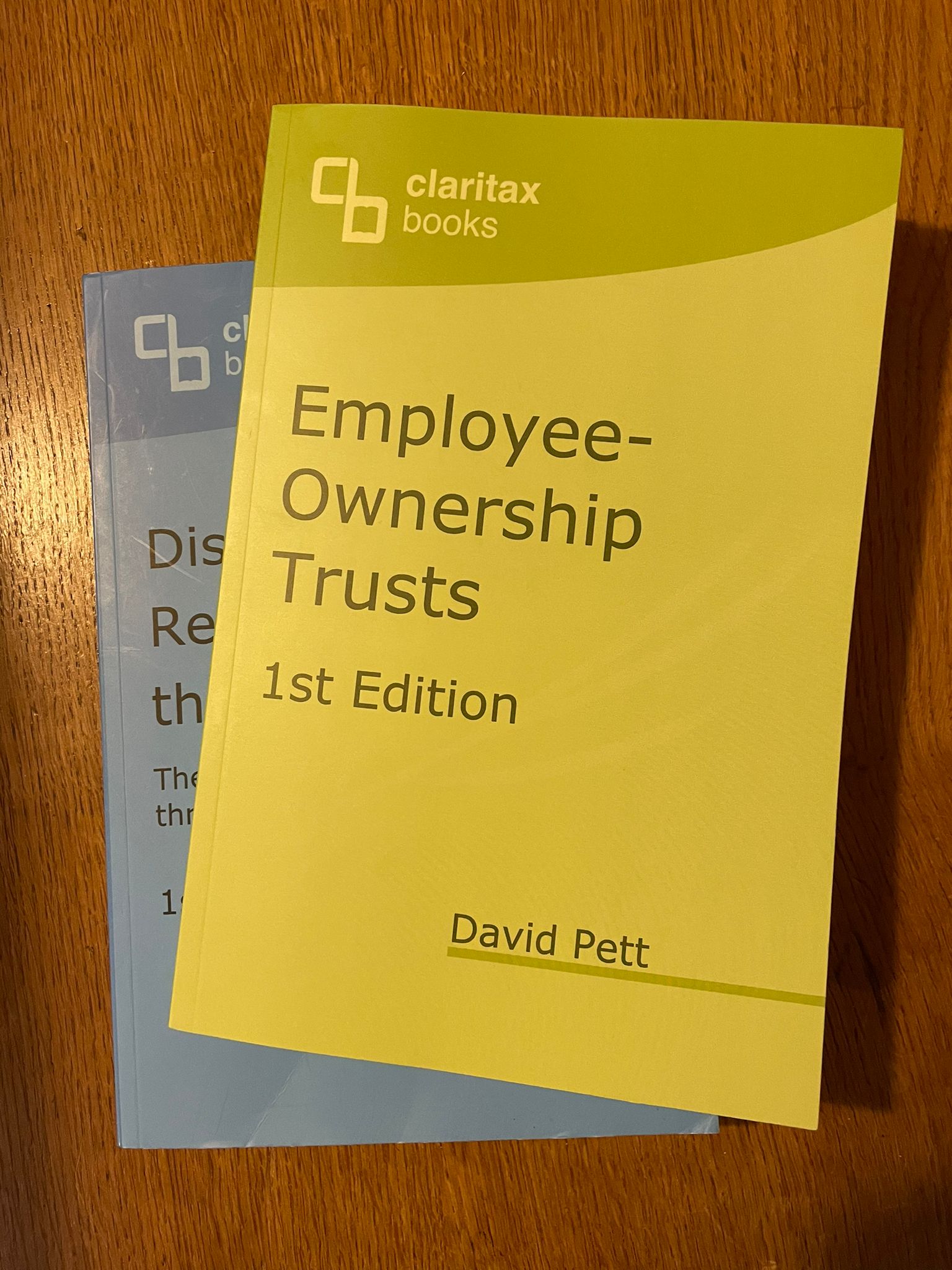
Claritax Books has just published the first edition of my latest book, Employee-Ownership Trusts. So far as I am aware, this is the only published work that focusses on the tax treatment of EOTs and associated transactions, as well as their structuring and financing.

EOT book photo for blog

Corporate trading businesses which are owned by trustees on behalf of employees can enjoy greater levels of employee engagement, offering the potential for higher productivity and more even distribution of the resulting financial rewards.

To achieve these goals, the owners of a company can sell their shares to an employee-ownership trust (EOT) for the benefit of the employees. When correctly carried out, this affords CGT relief for the vendors on the sale to the trust and allows the company to pay tax-free bonuses to all its employees.

Interest in employee ownership in general, and in the EOT model in particular, has grown rapidly in recent years. The conditions for gaining the tax benefits are complex, however, so this timely volume offers an accurate and comprehensive guide to the relevant rules.

For more information, please visit http://claritaxbooks.com

EMI “Call for Evidence”: My Response

The government announced in the 2020 Budget that it would review the EMI share option scheme to ensure it provides support for ‘high-growth’ companies to recruit and retain talented employees and examine if a wider range of companies should qualify to grant EMI share options. To this end a “Call for Evidence” was published by HM Treasury in March 2021 (see: https://assets.publishing.service.gov.uk/government/uploads/system/uploads/attachment_data/file/965555/Enterprise_Management_Incentives_Call_for_Evidence_2021.pdf ).

Click here to download David Pett’s response to that Call for Evidence. It sets out a number of suggested changes which could be made to the EMI Code to make it easier for qualifying companies to make best use of the tax-advantaged grant of EMI share options and to remove existing “traps for the unwary”.

The response will be of interest to anyone advising a company or its shareholders on the adoption of an EMI scheme or the grant of EMI share options.

Tax Avoidance in Dagenham

I have written to the Sunday Times in response to their article published on 21 March:

Dear Sir,

The article “It’s not just the rich that avoid tax: it’s teachers and nurses too” (March 21) is a fine example of lazy journalism, the content having been gleaned from an HMRC corporate report (https://www.gov.uk/government/publications/use-of-marketed-tax-avoidance-schemes-in-the-uk/use-of-marketed-tax-avoidance-schemes-in-the-uk ) and relayed without challenge. The idea that all lower-income workers involved in arrangements of the type described should be treated as deliberate “tax avoiders” is absurd, given that (a)  it has often been a condition of securing paid work that they do so; (b) it has been falsely represented to them by supposedly reputable organisations that the arrangements have been approved by counsel and by HMRC; and (c) it is unreasonable for HMRC to assume that such individuals have a sufficient understanding of the complexities of our tax laws to appreciate that they are being lured into tax avoidance. This is all the more disturbing, given allegations that HMRC has itself engaged workers paid through such arrangements.

As the HMRC report recognises, the promotion of tax avoidance is not, on its own, a criminal offence. Until it is, it is difficult to see how the government will succeed in preventing ordinary people falling victim to the organisations profiting from the misunderstanding of workers intent on securing remunerative work. Your journalist should perhaps be asking government why, according to recently published consultation documents, it still does not propose to criminalise the involvement of individual officers, directors and company owners in such promotion. To establish guilt, it could be provided that a judge or jury is asked to determine if an arrangement has been “promoted”, once the Upper Tier Tax Tribunal or the High Court has determined, on application by the prosecuting authority, that the arrangement is or involves “abusive tax avoidance”.

Yours faithfully,

David Pett

Unscrupulous Promotion of Tax Avoidance to NHS Workers

BBC Radio 4’s “Money Box”[1] programme has investigated unscrupulous ‘umbrella companies’ targeting those retired nurses and other NHS staff returning to work to assist in the response to the Covid-19 pandemic, as well as new hires for the ‘track and trace’ system. I was asked to respond to questions from the presenter, Paul Lewis, about the tax consequences, for the individual workers, of the actions being taken by such umbrella companies.

Given the impermanent nature of employments of this kind, these individuals will normally be required to secure their engagement through an agency. For an agency worker, the agency or its intermediary is normally responsible for payment of the remuneration earned after first deducting tax and NICs under PAYE.

So-called umbrella companies, interposed between the agency and the individual, can play a useful role in those cases in which an individual may expect to enter into multiple successive engagements and wants to offload responsibility for the paperwork and tax compliance associated with such multiple engagements. However, some umbrella companies are promoting their services on the basis of being able to secure that the individual receives a higher amount of net earnings by structuring payments to the individual as if part only is a payment of remuneration, subject to PAYE, the balance being paid as either an “investment payment” (i.e. the umbrella company supposedly making an investment in the individual) or an “advance on a future bonus” and (so it is claimed) therefore being free of tax.

As the programme made clear, this is a form of abusive tax avoidance. Agency workers are deemed to be employees of the agency (s44 ITEPA 2003) and are liable to tax and NICs under PAYE on the whole of the  remuneration they earn including “every form of payment, profit or benefit” (s47). It is not sufficient, to avoid tax, simply to describe payments of remuneration as something else. To do so poses serious financial risk for both the individual worker and the agency involved. If the intermediate umbrella company fails to deduct and account for tax and employee’s NICs when making such payments, HMRC will look to recover the tax, with penalties and interest, initially from the agency (as the intermediary payee is invariably offshore) or, if it remains unpaid within 30 days of a Reg 80 determination being made on the agency, from the individual on the basis that it is a payment of ‘disguised remuneration’ (the umbrella company being a ‘relevant third person’).

It was said, by the so-called brokers marketing the services of such umbrella companies, that the arrangements made had been confirmed by counsel to be legal. If that is correct, such opinions are simply wrong or (as has been found to be the case in the past) do not in fact state what they are purported to assert.

It goes without saying that individuals and agencies should avoid entering into such arrangements. When what is offered seems too good to be true, it probably is. In this case, it most certainly is.

The programme later suggested that the actions of such umbrella companies were analogous to the arrangements formerly widely used to structure remuneration in the form of loans from a trust which were not expected to be repaid. The government eventually responded to those arrangements with the 2019 ‘Loan Charge’ which has enraged campaigners as it has had a serious financial effect upon those workers who were either lured into or obliged to enter into such arrangements. However, the present actions of certain umbrella companies, in purportedly describing remuneration paid to a worker as something it is not, is very different. This is simply ‘calling black, white’. If done with the intention of cheating the Revenue, this could have serious consequences for those involved.

Perhaps the real issue here is whether HMRC has sufficient powers and resources to penalise, where appropriate, those who devise and promote or market such abusive tax avoidance arrangements, particularly if they are operating outside the UK.

HMRC does have powers to impose sanctions and civil penalties, both (i) for failure to disclose tax avoidance schemes under the DoTAS regime and, under legislation made in 2014 and 2017, (ii) if persons persist in the promotion of schemes after earlier schemes have been defeated, or they have enabled tax avoidance by devising, marketing or facilitating a tax avoidance arrangement. Under the ‘penalties for enablers’ rules, anyone who designs, markets, or otherwise enables tax avoidance may incur a penalty equal to the fees it has generated from the arrangement.

The problem is that, if the promoter is an offshore company, it can easily be liquidated and the individuals behind it can, all too easily, escape such sanctions.

If HMRC can identify the individuals concerned and adduce sufficient evidence of wrongdoing, they might seek to bring criminal charges for, say, conspiracy to cheat the public revenue. However, the threshold needed to secure a conviction is high, and this can prove challenging. If the individuals concerned are in countries with which the UK does not have agreements for reciprocal enforcement of criminal sanctions, such efforts may be fruitless. HMRC announced earlier this year that criminal charges had been brought against a number of individuals in the UK, although it was unclear as to what forms of evasion these arrests related. The alleged offences included “conspiracy to cheat the public revenue”, “conspiracy to evade income tax and NICs”, “fraud by abuse of position” and “conspiracy to transfer, disguise or convert criminal property”.

The question is: does HMRC have the necessary resources to root out promoters where offences have been committed?

[1] First broadcast on Saturday 6th June at 12:04 p.m and currently available on the BBC Sounds app.