Help from HMRC….or is it really?

I am highlighting a small point, of restricted interest to those involved with employee share schemes, but one which suggests that standards may not be what they were at HMRC.

Last month, HMRC published a revised Helpsheet 287 on the topic of the CGT consequences of disposing of shares acquired under a tax-advantaged employees’ share scheme. (https://www.gov.uk/government/publications/employee-share-and-security-schemes-and-capital-gains-tax-hs287-self-assessment-helpsheet/hs287-capital-gains-tax-and-employee-share-schemes-2025). This has excited some interest, as it clarifies how, by arranging for shares to be transferred directly from an SAYE share option scheme or a SIP into an ISA or personal pension arrangement, individuals may avoid triggering a liability to capital gains tax. However, it goes on, in para 16, to suggest (as did earlier helpsheets) that relief from CGT is available to both employees and non-employees who sell shares in an unlisted company to the company’s SIP trustees:

This relief is designed to encourage shareholders disposing of their unlisted shares to sell them to the trustees of the company SIP for the benefit of all the employees of the company. You do not have to be an employee to claim it.”

There follows a note of how to claim the relief.

To the casual reader, this appears to be an attractive prospect, enabling any individual or corporate shareholder in an unlisted company to avoid CGT by selling their shares to SIP trustees.

What it fails to highlight is the key condition for the relief (which is afforded by s236A and Schedule 7C, TCGA 1992), namely that the SIP in question must hold/acquire (including shares awarded to, or acquired on behalf of, plan participants as Free, Matching or Partnership Shares) not less than 10% of the issued share capital of the company.

In practice, the relief (a form of CGT rollover relief, as the proceeds must be reinvested) is of very limited application, and certainly not as readily available to all and sundry, as the Helpsheet suggests. It is as if an officer at HMRC only read the first para of Sch 7C TCGA and did not bother to read the conditions in paras 2 and 3.

At best, it is hardly fair to “dangle the carrot” of relief from CGT without signalling that the detailed conditions mean that it is of only limited interest or application. “Help” is not what this is!

New Edition of “Employee-Ownership Trusts”

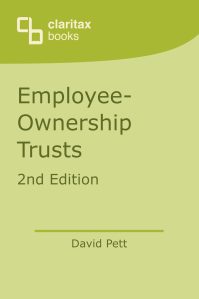
Cover of Employee-Ownership Trusts, second edition

Intended for all those advisers, trustees, officers and directors of companies owned by, or to be sold to, an Employee-Ownership Trust, the second, revised and enlarged edition of my book, “Employee-Ownership Trusts” has just been published by Claritax Books, priced at £95 + postage.

So far as I am aware, it remains the only comprehensive guide to the tax and legal issues around the establishment and operation of an EOT and the corporate governance of a company acquired by the trust and will be of interest to all lawyers, accountants, trustees, and other advisers, vendors of shares to an EOT, as well as all those involved with an EOT-owned company.

The work covers all of the changes made by the Finance Act 2025 to the tax rules relating to EOTs and includes much that has been gleaned from experience of advising proprietors, companies and EOT trustees since the book was first published in 2022.

For more details, and to order a hard copy, visit: https://www.claritaxbooks.com/product/employee-ownership-trusts/

When, if ever, does Abbott v Philbin still hold good?

In Michael Saunders v HMRC ([2024] UKFTT 300 (TC)), the First Tier Tax Tribunal has held that a cash payment received by an ex-employee pursuant to the terms of “share appreciation rights” (“SARs”), awarded under an L-TIP established by the holding company of his former employer company, fell to be taxed as employment income when received. It was not, as the appellant contended, a sum derived from the SARs which, in line with Abbott v Philbin ([1961] AC 352), fell to be charged to income tax only when first awarded (as “money’s worth” which constituted an emolument of the employment at that time).

Under the terms of the SARs, Mr Saunders was entitled to a payout of an amount, calculated by reference to growth in value of shares in the holding company, if (i) his award had “vested” when he ceased employment and, (ii) the company was, inter alia, sold within 2 years after he ceased employment. In the event, the company was sold within two years after Mr Saunders had ceased employment holding vested SARs. The substantial sum to which he therefore became entitled was received by him in the overseas portion of a split tax year in which he became permanently resident outside the UK. Even if the payment was of general earnings, it was, so he argued, outside the scope of the charge to UK income tax as being attributable to the overseas part of a split year (per s15(1A)(a) ITEPA 2003).

Rights under such SARs are neither securities nor securities options and do not fall within the scope of the charging provisions in Part 7, ITEPA 2003. What Mr Saunders was granted was a conditional entitlement to future payment of a cash sum of an amount dependent upon growth in value of shares in the grantor company.

In Abbott v Philbin, the option purchased on favourable terms by the employee was “something” that could be turned into money (albeit that, by its terms, it was non-transferable). The terms of the option did not link its exercise to continued employment or the circumstances in which Mr Abbott might cease to hold the employment. It was the acquisition of the option itself which was the taxable perquisite from employment and not the gain realised upon subsequent exercise of that option. The gain realised upon its exercise was derived from that asset, not from the employment. (That decision was, of course nullified, at least in relation to the grant of “rights to acquire employment-related securities”, by what is now Chapter 5, Part 7, ITEPA. However, it is still good law to the extent that it has not been reversed by statute.)

The question for the Tribunal was whether, in this case, the SARs amounted to “something” which was itself an emolument of the employment taxable when acquired by the employee, or whether the sum eventually paid, being an amount paid pursuant to what was a conditional contractual entitlement to a sum of money, was derived from the employment, not from that “something”. The Tribunal held that the receipt of the payment arose from the employment relationship, not from the SARs. The terms of the SARs were closely linked to the employment. It did not matter that the quantum of payment was not directly and specifically linked to the performance of the duties of that employment. It was part of the reward for his services and comprised general earnings for the period of his employment since the award was made. By reason of s17 ITEPA, the general earnings were “for” the last of those earlier tax years but, by reason of s18, were taxable in the tax year of receipt. It was not attributable to the overseas part of the split tax year in which it was received.

The decision did not explore the parameters of exactly what would amount to the grant of rights (not being rights to acquire securities) which is taxable as an emolument at the time of grant per Abbott v Philbin, but was content to rely upon the idea that the sum eventually paid derived from the employment, not from such rights. The question is important in the context of identifying the correct UK tax treatment of different forms of employment-related cash-based incentive awards made by US and other overseas companies to internationally-mobile employees. Does a liability to UK employment taxes arise at grant/award (per Abbott v Philbin), or only at the later time when the benefit of the award is satisfied by a cash payout? This decision suggests that it is difficult to craft a form of contingent contractual entitlement to a cash sum linked to ongoing employment which amounts to something capable of being converted into money or something of direct monetary value so as to be a taxable emolument when first received.

………………………………………..

David Pett

14th May 2024

Selling an EOT-Owned Company: Can It Be Done, and What Are the Consequences?

It is now ten years since controlling interests in companies were first sold to “employee ownership trusts” or “EOTs” (as provided for in the Finance Act 2014). Perhaps not unexpectedly, some of those companies are now being sold on by the trustees, and the EOTs are being brought to an end. However, given that the original policy intention was to encourage the long-term ownership of such companies for the benefit of their employees, there is invariably a tension between that and the idea that the company should now be sold on, typically to a trade purchaser. In particular, it is all too easily assumed that if, by doing so, the trustees are able to discharge their outstanding liability to the original vendors, that must be in the financial interests of all concerned, including other shareholders and those employees holding options to subscribe for shares in the company, and is therefore “a good thing”.

Who are the beneficiaries of the EOT?

However, the first question – often overlooked – must be: is a sale by the trustee, of its controlling interest in the EOT-owned company, really in the best interests of the beneficiaries of the EOT as a class?

To answer this, it is necessary to identify who exactly are the members of the class of beneficiaries. This will depend upon the drafting of the trust deed. They will typically be either (a) all employees, past, present and future, or (b) those individual current and former employees in whose favour the trustee may exercise its dispositive powers, these being defined in a manner consistent with the statutory “all-employee benefit requirement” (for the initial relief from capital gains tax afforded to the original vendors of shares to the EOT). If the latter, the trustee must also identify at this stage all those who are “excluded participators” as defined in s s236J(5) (which should have been mirrored in the trust deed).

Such a sale must be for a consideration which is not less than the market value of the shares sold. The trustee will need independent professional valuation advice to support their acceptance of an offer on terms which include a given level of immediate and deferred and/or conditional consideration.

Is a sale in their best interest?

Having identified who are the members of the class of beneficiaries, the next question for the trustee is whether a sale, and the tax and commercial consequences of such a sale, would be in their best interests as a class? Whilst “the best interests” has been taken to mean “the best financial interests” (per Sir Robert MeGarry VC in Cowan v Scargill [1985]), more recent decisions suggest that broader factors, such as future security of employment, may be taken into account.

Too often, the suspicion is that, whilst a sale may clearly be in the best interests of the original vendors (if they are owed money by the trustee), if the tax and financial consequences for the trustee and beneficiaries are such that there will be little or no cash benefit to the beneficiaries (who may, in consequence of a sale, lose job security and pension entitlements), it may be difficult to see on what basis a body of trustees, acting reasonably, could conclude that such a sale is in best interests of the beneficiaries.

It is worth noting that:

  • the trustee, or directors of the trustee company, have a duty to determine such questions independently and without regard to their personal interests;
  • the trustee should be separately advised – meaning that it is not sufficient for the lawyers acting for the EOT-owned company and/or the original vendors to procure the provision of advice by different teams after “Chinese Walls” have been put up between them. Rather, the trustee(s) should appoint distinct legal advisers who have no conflict of interests with those of other interested parties such as the original vendors or the EOT-owned company itself. (See the comments of the judge in the case of South Downs Trustees [2018].
  • ceasing to meet the “controlling interest requirement” will trigger a disqualifying event giving rise to a clawback charge to capital gains tax on the part of the trustee (calculated by reference to the base cost of the original vendors). This, when added to the amount of any outstanding consideration due from the trustee to the original vendor(s), plus any interest thereon, will eat into the net proceeds available for distribution to beneficiaries.

Reducing the tax cost of a sale

It has been suggested by others that the clawback charge may be avoided by the trustee first distributing its shares in the EOT-owned company to beneficiaries. The thinking here is that, if the shares are transferred out for a nil consideration, the trustee is protected against any charge to CGT by s 239ZA TCGA 1992, and no further clawback charge may then arise. In my view, this is not correct. Even assuming that the grant of such options is structured to avoid breaching the “all-employee benefit requirement” (which may, in practice, be difficult to achieve), a clawback charge would be triggered immediately before the controlling interest requirement ceases to be met, and in advance of the disposal of shares by the trustee. However, if the EOT-owned company, or an employer subsidiary, is able to claim relief from corporation tax under Chapter 2, Part 12 CTA 2009 for the value of the shares so acquired by the employees, this will enhance the value of that company and, presumably therefore, the amount of consideration paid to the EOT. That said, as HMRC appear to treat a company under the control of an EOT with a corporate trustee as being under the control (per s1124 CTA 2010) of another company (hence the need for the wording in parenthesis in para 27(4)(d) of Sch 2 (SIPs) of ITEPA 2003), it will be necessary – if a claim for such relief is to be relied upon – to ensure that the EOT trustee is not, or is not solely, a corporate trustee.

If the trustee or trustee directors are in breach of their duties, they will be at risk of a class action by or on behalf of beneficiaries for damages for breach of trust. The Roadchef saga is illustrative of the fact that, if a law firm is able and willing to take on such a challenge on a “no win, no fee” basis, the risk to the individual trustees or trustee directors could be real and significant – particularly if they are held to have benefitted personally from the sale.

Conflicts of interests

If, as is not uncommon, trustees or trustee directors include an original vendor and/or a director of the EOT-owned company, it is necessary to examine carefully the provisions of the trust deed and the articles of association of the EOT-owned company to understand what if any provisions apply to relieve such individuals of the consequences of conflicts of interests arising from them acting in different capacities. If necessary, an individual may need to recuse themselves from any participation in the decision-making which may, in turn, give rise to issues of quorum and capacity of the trustee(s) to determine matters relating to the sale.

Who is eligible to participate in a distribution of net, after-tax, sale proceeds?

A further point for the trustees to consider is how, and when, any net proceeds of a sale of shares in the EOT-owned company are to be distributed amongst the members of the class of beneficiaries. Those eligible to participate in any distribution must, if the EOT-owned company is sold, include those ex-employees who have left within the 2 years ending with the sale (see s236J(4) TCGA). Those employees who leave after the sale by the EOT will remain members of the class of beneficiaries and, if they die and the trust deed so provides, their personal representatives will remain beneficiaries for a period of 12 months thereafter.

A question often asked is: can new joiners, after the sale, be excluded from participation? Typically, the directors of the company being sold, and its new owners, would wish to do so on the basis that value accruing up to the point of sale should benefit only those who contributed up to that time. Against that argument is the assertion that crystallising entitlements at the time of sale results in a two-tier workforce – those with an interest in any distribution, and those without. If the amount of sale consideration, and therefore any distribution, is dependant upon a post-sale “earn-out”, this could afford a disincentive on the part of those so excluded from participation in a distribution.

However, the position is not entirely clear and depends upon the interpretation of s170(1)) TCGA – defining what is a member of the group of companies – and s236J(3) TCGA. The trust deed will restrict the distribution of trust assets to those who are “eligible employees”, as defined. Even if the better view is that new joiners should participate, so that their exclusion is technically a breach of the all-employee requirement, the question is “so what”? Once a disqualifying event has occurred and the clawback charge (if any) has been accounted for, HMRC presumably have no further interest in policing compliance by the trustee(s) with the “relief requirements”. The company could possibly afford some protection for the trustee by imposing, as a term of employment, a disclaimer of benefit (although quaere is this “a written request from” the new joiner – see s236K(1)(c)?).

The eligible employees, amongst whom any distribution must be made, will necessarily exclude “excluded participators” as defined in s236J(5). This will mean that, for these purposes, the class of eligible employees will differ from the class of eligible employees to whom annual tax-free bonuses may have been paid. If the trust deed so provides, non-executive directors of the EOT-owned company and its subsidiaries who are not otherwise eligible employees may also be excluded.

How is the available sum to be divided amongst those eligible?

Having identified who must participate in a distribution from the EOT, the next question is how the amount to be so distributed is to be divided between them, bearing in mind that there may be a series of distributions if the sale consideration is not immediately received in full.  The legislation allows for amounts to vary according to different levels of remuneration, length of service and/or hours worked, provided such differentiation is on a linear basis weighing each such factor separately, but every eligible employee must receive something in each distribution. The legislation leaves open the question of whether such factors are to be applied at the time of the sale or the later time of a distribution.

Logically, it would be the former, as crystallising entitlements as at the time of sale operates most fairly and, otherwise, a post-sale salary increase (for example) could unfairly increase an eligible employee’s entitlement, relative to that of others on the same rate of pay at the time of the sale. Likewise, if determined as at the time of distribution, the passage of time could unfairly alter relative individual entitlements.

Distributions are taxable as employment income

Amounts distributed are taxable in the hands of recipients as employment income, and attract NICs, to be accounted for under PAYE. If the distribution represents the net proceeds of sale of the EOT-owned company, this is unfair when compared with the tax treatment of other shareholders who will typically suffer only capital gains tax. It is a concern which has prompted representations to government in response to the 2023 consultation on EOTs.

……………………………………………..

4th May 2024

More About the Loan Charge

Those who follow the debates about the impact of the 2019 Loan Charge on employees and directors who had outstanding loans made to them by an employees’ trust or other third party will be interested to read the following exchange of letters between the Parliamentary Treasury Select Committee and the head of HMRC:

Letter from Chair of the Treasury Select Committee to Jim Harra dated 5 February 2024

https://committees.parliament.uk/publications/43894/documents/217675/default

Letter from Jim Harra dated 11 March 2024 in response:

https://committees.parliament.uk/publications/43895/documents/217677/default

Jim Harra’s response to specific questions asked by the Committee about the Loan Charge, is – at least in part –  a masterpiece in “yes Minister”-style obfuscation and half-truth. Specifically, the answers to questions 2 – 5 give only a partial picture of how disguised remuneration tax avoidance schemes were established and operated in the decade or more before 2010.

Those questions were:

1. Please provide a diagram of how typical disguised remuneration schemes work.

2. Please provide the Committee with a timeline regarding disguised remuneration schemes and HMRC efforts to tackle them, beginning in 2000. This should include, but not be limited to:

the development of such schemes, HMRC actions, court cases and legislative initiatives, including the General Anti-Abuse Rule (GAAR).

3. Given the above timeline, is HMRC confident that it acted swiftly in seeking to counter disguised remuneration schemes?

a) Please list any constraints HMRC faced in its actions and the effectiveness of any measures taken by HMRC or HMT listed in the timeline.

4. Were HMRC confident that the department was in a position to win disguised remuneration cases in court prior to the introduction of the Loan Charge legislation? If so, how long would it have taken to clear all the cases through this route alone?

5. Without the Loan Charge legislation announced at the 2016 Budget, what courses of action would have been available to HMRC?

a) Did you cost those options at the time and what were their estimated costs?

Most importantly, it is necessary to correct the impression given by Jim Harra that HMRC had judicial authority for its campaign to recover income tax on (real) loans made by trusts funded otherwise than by way of “re-directed earnings” before 6 April 2011, and that the actions it took were the only courses of action reasonably open to it.

The making of loans from a trust, as a means to avoid PAYE tax and NICs on moneys advanced to a director or employee, was becoming a widespread practice amongst both listed and independent private companies well before 2000. The use of such structures to avoid tax was made known to HMRC officials on multiple occasions in the 1990s, and concern was expressed at the loss of tax and failure on the part of HMRC to respond effectively or at all. The idea of using such loans from a trust to avoid income tax and NICs can be traced back to material published by respected counsel in or about 1992, relating to the taxation of employees’ trusts.

It was suggested to HMRC well before 2010 that new legislation could impose a “loan to participators” – type charge[1], which is a primary liability of the employer, if it (or a connected company) causes monies to be put beyond the reach of its creditors by funding a trust. The tax deposited might then be available for credit against PAYE liabilities to income tax arising on the provision of benefits out of the trust. Alternatively, or in addition, a charge similar in effect to the 2019 “loan charge” could have been imposed at a much earlier date if any form of beneficial employment-related loan was not repaid in full after, say, 5 years.

When, in 2010, a draft of the Disguised Remuneration legislation was disclosed by HMRC officials to selected advisers for comment, it was queried why the charges to income tax were structured as charges on individual employee beneficiaries, and not as a primary liability of the employer. The response was that Ministers were anxious to avoid the new charge to tax being perceived as an additional tax on businesses.

In those cases in which an advance of moneys to an employee or director was purported to be a loan, but the facts supported the view that any such loan was a sham, HMRC had good authority on which to recover tax on the basis that the advance was a payment of earnings (see, for example the case of Philip Boyle v Revenue & Customs ([2013] UKFTT 723)).

Until 2015, HMRC sought to assert that the making of a loan to an employee by trustees in circumstances in which there was no expectation of repayment until after the death of the employee was, in effect, an earmarking of the funds (similar to the idea of an earmarking described in the Disguised Remuneration rules[2]) and that this was itself a form of payment of earnings which was liable to income tax and NICs, for which the employee is liable but which is collected from the employer under PAYE. It was only in that year, and in the course of the litigation with Glasgow Rangers’ football club (“the Rangers’ case”[3]), that HMRC changed tack and argued instead that it was the contribution made to the trust which, if on the facts was a payment of re-directed earnings of the employee, was liable to income tax and NICs.

This, however, was not a complete answer to the avoidance of tax by the use of loans from a trust. In many instances it was clear that the funds in the trust did not represent payments of re-directed earnings of specified employees. In the case of such loans (assuming they were genuine and not sham loans) made before the introduction of the Disguised Remuneration rules in 2011, there was no judicial authority supporting the imposition of a charge to income tax on the making of such a loan – although more modest annual charges arose under the “benefits-in-kind rules”. Settlement agreements secured by HMRC have, in many cases, been (in effect) imposed on the basis of a questionable representation of the law as it then stood. It is no answer for HMRC to assert that, whilst HMRC has power to collect income tax from an employer under PAYE, it is also justified in side-stepping the PAYE rules and collecting it directly from the employee: if there was no general earnings charge on the making of a genuine loan, the collection mechanism is not in point.

The truth is that, for more than a decade until 2010, HMRC were like the proverbial rabbit stuck in the headlights, aware of the issue but unable or unwilling to respond effectively by securing an early change in legislation and/or securing judicial guidance in all those situations in which real loans (etc) were not made out of re-directed earnings.

………………………………………….

David Pett

March 2024


[1] See s455 Corporation Tax Act 2010

[2] See s554C ITEPA 2003

[3] RFC 2012 Plc (in liquidation) (formerly The Rangers Football Club Plc) v Advocate General for Scotland [2017] UKSC 45

Tax Journal Interview

Published on 15 March 2024. See original article here

One minute with…David Pett

David Pett is a tax barrister at Temple Tax Chambers. Whilst he advises on all direcct taxes, David is best known for his advice on the income tax, PAYE, NICs and CGT aspects of employees’ and directors’ remuneration, incentives, and all aspects of employment-related securities and employee share plans.

What’s keeping you busy at work?

At present, I am principally fielding technical queries about the disguised remuneration rules, employee share schemes and sales of companies to employee-ownership trusts (“EOTs”), although my practice extends to all direct taxes and related trust and company laws.

If you could make one change to a tax law or practice (anywhere in the world) what would it be (and why)?

It would be to allow trustees of a bona fide employees’ trust holding ordinary shares of the principal class in the employer company or group to receive distributions free of UK tax provided that, within, say, 30 days, they are fully distributed amongst beneficiaries on an “all-employee and similar terms” basis. Subject to safeguards against abuse, such amounts should then be taxed as dividend, not employment, income in the hands of existing and ex-employees. This would encourage the collective ownership of shares in (especially P/E-backed) companies, and meaningful financial participation, for the benefit of all of a company’s employees.

Is there anything you know now that you wish you’d known at the start of your career?

How enjoyable and intellectually satisfying life as a tax barrister can be. I transferred from practising as a solicitor in 2017 but should have done so 20 years ago! The support of my clerks and of other members of chambers has been fantastic and helped me to produce two new tax books in 2021 and 2022 (Claritax guides to Disguised Remuneration and Employee Ownership Trusts), and to accept instructions on, and deal with, some very challenging and high-value matters. Being entitled to lunch in Hall in the Inns of Court is also a tremendous benefit.

Who do you see as your mentors over the years?

David Gottlieb, then head of tax at Clifford-Turner (and who died prematurely at the age of just 39), in the early 1980s, instilled in me both the need to examine all the detail and the maxim “always assume you are wrong and question your own opinion” (He would then add: “always assume your adversary is more right than you are…. but still assume they too are wrong.”). He gave me the time to study, understand and absorb the tax, trusts and company legislation without the pressure to meet financial targets. It was a fantastic training.

Is there a recent tax case has caught your eye (and why)?

The 2023 decision of the Supreme Court in HMRC v Vermilion Holdings Limited has given rise to widespread uncertainty as to what is and is not an employment-related security or option, falling within the charging provisions of Part 7, ITEPA 2003. The ratio is that the deeming provision in s471(3) is a “bright line rule”, but the conflation of identifying who provides shares or share options with that of identifying who provided the right or opportunity for an employee to acquire them, has muddied the waters.

What should we be looking out for later this year?

Getting one’s head around the proposed new residence-based tax regime for non-doms will be a challenge this year, but an important issue ignored in the Budget, is the ongoing plight of those lower-paid employees caught in the Loan Charge scandal as a consequence of HMRC’s failure to act effectively, or at all, when tax avoidance schemes for contractors and others were being peddled in full sight. The resulting penury for so many caught up in HMRC’s zealous efforts to recover tax from the victims, rather than the promotors of such arrangements, in a scandal not dissimilar to that of the Post Office saga.

Finally, you might not know this about me but…

Since a teenager, I have pursued a parallel career as an orchestral timpanist. This has afforded opportunities to play much of the symphonic repertoire and in some of the finest concert venues in Europe. There is nothing like participating in a performance of a Tchaikovsky or a Mahler symphony for shedding frustrations and angst. I still enjoy time spent at the back of a large ensemble of musicians – much of it counting bars – and conquering the fear of coming in at just the wrong moment! It has some similarities with appearing before a court or tribunal.

Encouraging Financial Participation by Company Employees

What should be the underlying policy objective and how could that be achieved?

It is generally agreed by politicians of all parties that it is a good thing “to enable employees to share in the growth in value of the business to which they contribute by their labour”.

We have, on the statute book, provision for various long-standing tax-advantaged arrangements for employees of an independent company to be able both to acquire, and then sell, shares in their employer company on favourable terms. Specifically, and presently, income tax and CGT reliefs are afforded (within limits) to ordinary shares in the employer company acquired pursuant to a Share Incentive Plan, and to the grant and exercise of options to acquire employer-company shares granted to all qualifying and eligible employees as savings-linked share options, and on a selective basis as Company Share Options (“CSOPs”) or, if the company itself qualifies, as enterprise management incentives (“EMI share options”). In addition, employers may be eligible for relief from corporation tax for amounts corresponding to employee share option gains and certain other amounts on which employees are charged to income tax on the acquisition of employment-related shares.

Since 2014, relief (indeed, complete exemption) from CGT has been available (if claimed) for sales by individuals and their personal trusts of shares in a trading company (or holding company of a trading group) to a special form of employees’ trust (an “employee ownership trust” or “EOT”) which thereby acquires a 51%+ controlling interest in the company within a single tax year. Provided all statutory conditions are met and there is no “disqualifying event”[1] before the end of the next tax year, the vendors escape all liability for CGT on their disposal of shares to the EOT.

This legislation affords a powerful incentive to proprietors of private companies to sell their shares to such an EOT. Indeed, so far, there have been over 1,500 companies sold to EOTs and the trend has accelerated for fear of changes or restrictions being introduced (although this government has said it will only amend, not withdraw, the relief). Typically, the EOT is funded by the company being sold making cash contributions out of distributable profits, the vendors having to remain as unsecured creditors of the EOT until future profits have been generated sufficient to put the trustees in funds to enable them to pay any outstanding consideration.

Whilst an EOT-owned company can pay annual tax (but not NICs)-free bonuses of up to £3,600 to qualifying employees, employee beneficiaries of the EOT cannot – unless the company or its business is sold on – individually benefit from growth in value. Even if the trustees subsequently sell-on the company, the amount received by the trustees – after a clawback charge to CGT on their part and the payment of outstanding consideration due to the original vendors – is unlikely to leave much ‘in the pot’ for the employee beneficiaries, and what is paid to them is taxed as employment income, not capital gain (see the example below).

The legislation is flawed, and experience suggests that in many cases the arrangements are structured with the primary objective of allowing a tax-free sale and extraction of profits, rather than with any real intention of enabling the employees to benefit from future growth in value or from the company being owned and controlled by trustees on their behalf. Nevertheless, the EOT-ownership model, which in many respects emulates the example set by The John Lewis Partnership, is held up by some as the ideal way to maintain independent private-company ownership on a sustainable basis. Whilst it may afford an alternative to a trade sale or a disposal to private equity, it should be remembered that there is only one John Lewis…..and look at where that is now!

Crucially, The John Lewis Partnership is not – and an EOT-owned company is not – an employee-owned company. It is a company owned and controlled by a trust, and the question to be asked is: who are the trustees, and who appoints and removes them?

Further, individual employees of John Lewis/Waitrose do not own shares in the group. “Partners” so-called might (but have not recently) receive annual bonuses out of profits – taxed as employment income. What they do not enjoy is any ability to benefit financially from the growth in value to which they contribute.

In my experience – having advised upon and devised the ownership structures of multiple employee-owned companies, employees’ trusts, and employee share schemes, beginning with the privatised bus companies in the early 1980s – the most successful private company ownership structures (in terms of resulting in substantial growth in value and employee satisfaction and reward) are those which:

  • have enabled individual employees to benefit financially from an appropriate share in the growth in value to which they have contributed by their labour over the period of their employment, and to do so in a manner which is taxed in the same way as if such gain was realised by a non-employee shareholding investor; and
  • have a corporate governance structure which, whilst allowing the views of employees to be identified and taken into account, includes sufficient checks and balances to ensure that the directors are free to manage the business in the best interests of all shareholders.

The case for change

There is a strong case for a change in the UK’s tax (and company law) regime to allow and encourage employees, workers and others who contribute their personal services towards the business of a trading company, to be able both:

  • to participate in dividends out of profits generated annually on shares held on their behalf collectively in a trust; and
  • to benefit from growth in value of shares which they may acquire on and after appointment, and dispose of on or after leaving (or after a reasonable holding period).

We need a regime which encourages sustainable independent ownership of successful businesses, not one which positively incentivises individual shareholders to sell out and run away. We need a UK version of the German “Mittelstand”. Very broadly, our existing tax regime encourages the sale of successful private trading companies. It does not, as in many European countries, allow and encourage the maintenance of independence through succession of family and employee ownership.

The idea of “companies with employee ownership” (as opposed to “employee-owned companies”) as being “a good thing” was recognised by the former coalition government and model documentation to support its implementation was published on the Dept for Business website in 2013 and still remains accessible. By contrast, the EOT regime was independently devised by HM Treasury (without consultation with the Dept for Business as it then was).

The policy behind the EOT legislation should be to balance the interests of company proprietors – so as to offer them a financially viable alternative to selling the company to a trade buyer or to private-equity or other investors – with those of employees who should be enabled to benefit personally from the growth in value to which they contribute and to do so in a manner which is taxed no less favourably than if they were private investors and not employees.

As things have stood since 2014, the balance is firmly in favour of the vendor proprietors who are afforded total exemption from tax, and giving little or no opportunity for employees (supposedly those persons for whose benefit the EOT regime was enacted – the clue being in the title!) to benefit, other than by limited enhancement to their taxable employment income. I give you an example to illustrate the current position:

Rather than sell a company worth, say, £10m to a trade buyer keen to acquire it, and accept a CGT bill (assuming entitlement to BADR) of 10% on the first £1m, and 20% thereafter, Mr X can instead (i) sell, say, 75% to an EOT for say £7m (discounted to reflect the size of the holding) of which, say £2m is paid upfront, and (ii) retain 25% with a view to waiting until after the end of the next tax year. Then, the trustees (who may well be effectively controlled by the original vendor(s)) agree[2] to join in a sale to the trade buyer for, say, £10m in aggregate. If the trustees’ 75% is sold for, say, £7.5m, the trust fund (after (a) tax of, say, 20% on their gain, over the, say, nil inherited base cost of Mr X, and (b) payment of the balance remaining of the consideration due to Mr. X (£4m)) is left with (£9m – £6.5m =) £2.5m to be distributed amongst the qualifying employee beneficiaries subject to PAYE income tax and NICs. Mr X will have received £7m tax-free, and £2.5m subject to CGT (of which £1m is at the reduced BADR rate of 10%).

I set out below a summary of what might be done:

  •  to improve the EOT regime in order to enable and allow individual employees to benefit from distributions of profits and capital growth, and
  • to enable all employees, workers, consultants and individual contractors of an independent company (or member of an independent trading group of companies) to benefit likewise and in a manner which is treated for tax purposes no less favourably than that afforded to other investors.

Companies controlled by an EOT

I suggest the following changes:

  1. Restrict relief from CGT for disposals of shares to an EOT to no more than the (discounted) market value of the respective holdings of shares sold by claimants.
  2. Remove the provision for tax-free annual bonuses payable by EOT-owned companies and, instead, provide an exemption from income tax on the part of the trustees of an EOT for dividend payments received from the EOT-owned company if:
  3. the dividends are paid out to eligible and qualifying employees on an “all-employee and similar terms” basis; or
  4. the dividends are retained by the trustee(s) and applied (within, say, 3 years) in the purchase of shares in the EOT-owned company from employees who leave or who, with the agreement of the trustee(s) wish to sell having held such shares for a minimum period (of 3 years?) for a consideration which does not exceed the pro rata value of such shares determined by reference to the “market value” of the company as a whole as agreed with HMRC SAV (or certified by a recognised share valuer).

This need not be limited, as are the annual tax-free bonuses, as – unlike the payment of such bonuses – the ability of the EOT-owned company to pay dividends is dependent upon the generation of distributable profits.

3.     Provide that such payments, made out of dividend income of the trust, to employees of an EOT-owned company (and ex-employees who have left for whatever reason within the past 12 months) are taxed as dividend income, not as earnings.

4.     Amend the existing tax rules so as to provide that disposals of ordinary shares in the EOT-owned company beneficially owned by employees (as “employment-related securities”) to the EOT for a consideration which does not exceed the pro rata market value described at 2(b) above is taxed as capital gain, not as employment income (see Chapter 3D, Part 7, ITEPA 2003).

5.     Allow ordinary shares in the EOT company to be appropriated to employees and/or sold to employees by way of awards under a tax-advantaged Share Incentive Plan without that being a disqualifying event (see footnote above), and for so long as such shares are beneficially owned by individual employees and held in the SIP, allow those shares to be counted towards the percentage ownership of the share capital of the company by the EOT (so that the aggregate of such SIP shares, together with those beneficially owned by the EOT must not fall below 50% + 1 if a disqualifying event is to be avoided).

The combination of such changes, together with changes to SIPs, which have been separately suggested in a response to the Call for Evidence by HMRC on SIPs and SAYE share options, would enable an EOT-owned company to allow its employees to benefit directly from sharing in the growth in value of the EOT-owned company over the period of their employment in a tax-advantaged manner (within the confines of a SIP).

The suggestion at 4 above would afford a commercial freedom to allow an EOT-owned company to enable its employees to benefit from such growth in value, subject to CGT, by way of other (existing) mechanisms for the acquisition and disposal of employee shares (such as the grant and exercise of EMI and CSOP, as well as “unapproved”, share options to subscribe for new shares or the operation of an internal market in employees’ shares).

Other more detailed and technical changes recommended to HM Treasury are set out in my response to a Call for Evidence earlier in 2023. The detailed response is to be found at : https://davidpett.tax/2023/08/20/employee-ownership-trusts/

Changes proposed to encourage financial participation by employees in other companies

The ideas put forward in items 2 and 3 above may also be applied to all other independent companies or groups of companies, not just those which are majority owned or controlled by employees or trustees. It is often asserted that it is wrong in principle to encourage employees, by participating in employee share schemes, to “put all their financial eggs in one basket” by becoming dependent upon the fortunes of their employer to secure their employment income, their pension, and their savings. By allowing, without tax disadvantages, an employer to fund an employees’ trust to acquire a tranche of ordinary dividend-entitled and non-restricted, or publicly-traded shares, to be held on a collective basis for the benefit of employees, past, present and future so as to allow them to participate as suggested above and without individual risk, would be attractive to many, including private-equity backed, companies. At present, for example, a loan by a closely-held company to an employees’ trust for such a purpose attracts a penal tax charge under the “loans to participators” rules.

Finally, many larger companies, both publicly traded and privately-owned, do have employees’ trusts which they use to warehouse shares pending their transfer to participants in share-based incentive arrangements (such as L-TIPs, Restricted Share Plans. JSOPs, Growth Share Plans, etc.). It has been repeatedly pointed out to HMRC and Treasury Ministers that the reason why companies typically appoint offshore (typically in the Channel Islands or Switzerland) independent trustee services companies, not UK trustees, as corporate trustee of their employees’ share trust, is that existing tax rules treat them more favorably than UK-resident trustees. Why the government has not at least “levelled the playing field” and allowed companies to repatriate their employees’ trusts without penalty or risk of CGT charges on gains in the trust, is a mystery.

The government is expected to make changes to the EOT regime in the 2024 Finance Bill. It remains to be seen if the wider changes sought will attract support from a new government in 2024.

…………………………………………………….

David Pett

Temple Tax Chambers

30th November 2023


[1] Such as a reduction below 51% of the EOT’s interest or a sale of the company or its business or a distribution of benefits otherwise than on an all-employee/similar terms basis.

[2] If, but only if, they are of the reasonable judgement that to do so is in the best financial interests of the employee beneficiaries.

Taxation of EBTs: Suggested Enhancements

My Responses to Open Consultation on Taxation of Employee Ownership Trusts and Employee Benefit Trusts – Part 7, Questions 9-12 – EBTs

Question 9 – making explicit that restrictions on connected persons benefiting be for the lifetime of the trust.

9.1 First, I have seen within instructions received a number of examples of tax planning for succession of ownership of a close company, based upon the opinions expressed by certain KCs, to the effect that death breaks any prior connectivity between a transferor and (typically) a child of the deceased transferor who is or has been an employee or director. If, therefore, the settlement terms grant the trustee power to exercise dispositive powers in favour of a member of the class of beneficiaries who, being an existing or former employee or officer of the body concerned, is not then so connected, such powers may (and are intended to be) exercised in their favour to the exclusion of other members of the class. The question of whether this interpretation is correct has not yet been the subject of judicial determination (and such an interpretation does appear to have been accepted by the GAAR panel – see Example D29), although, as mentioned in the Consultation document, doubt has been cast by members of the Court of Appeal.

9.2 Secondly, neither I, nor (so far as I have gleaned from conversations with a number of solicitor practitioners) other specialist advisers on employee share plans have any objection in principle to the idea of pre-empting any such judicial determination by amending ss13, 28 and 75, possibly with retrospective effect, so as to put beyond doubt that, to qualify for exemptions from inheritance tax, the trust must positively exclude from benefit (otherwise than in the form of income chargeable to income tax – see below) at any time – and specifically both when the disposition or transfer is made into the settlement (“Time A”) and when the trustees exercise their dispositive power (“Time B”) –  any person who:

  • is at Time B a participator in (a) the close company whose shares are or have at any time been held in the settlement, or (b) the close company which made the disposition to the settlement, or (c) any other company connected or associated with (a) or (b);
  • is at Time Aor was, at any time in the period of 10 years before Time A, a participator in (a) the close company whose shares are or have at any time been held in the settlement, or (b) the close company which is making the disposition to the settlement, or (c) any other company connected or associated with (a) or (b);
  • was a participator in any other close company which has made a disposition into the settlement, or was a participator in any such company at any time within 10 years before such a disposition is or was made;
  • was, at or within 10 years before Time A, connected with any such person, or is at Time B, or has at any time since Time A been, connected with any such person.

Question 10 – should shares need to have been held for 2 years before transfer into an EBT to qualify for relief from IhT on transfer in?

10.1 It is difficult to support this proposal without understanding the policy reason behind it and the mischief it seeks to address – neither of which is explained in the Consultation document. I have seen examples of start-up companies whose founding shareholders have been anxious to “ring-fence” a proportion of the issued share capital for the benefit of employees and have formed an EBT for perfectly legitimate and understandable (non-tax) reasons very soon after the company was formed. The fact that a founding shareholder transfers into trust a proportion of the shares for which he or she has subscribed, rather than put the trustee in funds to subscribe for shares, should not of itself disqualify the trust and its settlor(s) from the benefit of IhT reliefs.

10.2 Again, if there is a company reorganization or reconstruction as a consequence of which an investor begins to hold shares in a new holding company, why should that person then have to wait 2 years before a transfer of shares into an EBT qualifies for relief?

10.3 I have not come across any example of tax avoidance, or tax planning, where the mischief (actual or perceived by HMRC) is, or might arise by reason only of, a transfer of shares into an EBT being made within 2 years of acquisition.

Question 11 – should those individuals who (i) may receive benefits in the form of income, and (ii) are connected to a participant, be restricted to no more than 25% of all those able to receive income benefits?

11.1 The first point which requires clarification is the meaning of s65(5)(b) IhTA 1984. Specifically, what is the policy intent behind, or what is meant by, “….income of any person for any of the purposes of income tax….”?

11.2 In practice, it is understood that HMRC interprets this as meaning “is actually charged to income tax in the hands of the recipient”. It is far from clear that this is correct.

11.3 At one end of the scale, it could mean income in the trust law sense of regular receipts from a subsisting source. Alternatively, it could mean a receipt which would fall to be charged to income tax but for the availability of a relief or exemption (such as, for example, the availability of double taxation relief under the Disguised Remuneration rules). Is the acquisition of shares pursuant to an employee share option, giving rise to a charge to income tax under Chapter 5, Part 7 ITEPA, to be regarded as “income for one of the purposes of income tax”? It is a capital gain specifically charged to income tax.

11.4 Surely, the policy debate should be whether, to qualify for IhT exemptions, participants and connected persons required to be excluded from capital benefit should nevertheless be permitted to take benefits in any other form, unless, perhaps, the full amount of benefit actually received or realised falls to be charged to income tax (and NICs?)?

11.5 The proposal as framed in terms of there being a maximum limit, of 25%, on the percentage of employees (and officers?) who may receive benefits which are charged to income tax (if that is the effect of what is proposed) appears arbitrary and to have unintended consequences. Is this restriction intended to apply only to close companies whose shares are held in the EBT, or which have made a disposition to the EBT?

11.6 At its simplest, a trust for the benefit of a large family-owned (close?) company (or group – see below) which has a large number of family members employed may find such a restriction to be unfair when compared with the EBT of another company employing an equal number of family members, but which has a larger workforce overall.

11.7 In applying the proposed restriction, how is the fractional limit to be defined? Who, at any given time, is within the denominating number of “employees who are able to receive income payments”? Will it extend to include all members of the class of beneficiaries who are, at that time, employees or officers of the company, or group, concerned? Or, is it intended to be confined to those employees who are excluded from participating by receiving benefit in a capital form, but are nevertheless still able to receive benefit in the form of “income for the purposes of income tax”?

11.8 Presumably, the numerator is intended to include all those persons mentioned in ss13(2) and 28(4), and not merely those who, not being participators themselves, are connected to a participator (as the question suggest)?

11.9 It is worth remembering that the “close companies” case of the Disguised Remuneration legislation in Part 7A, ITEPA 2003 (s554AA et. seq.) goes a long way to protecting the Treasury by ensuring that benefit received from an EBT, even if not referable to an office or employment, is brought within the charge to income tax. This does not, however, apply if there has been no “relevant transaction entered into by a close company” (per s554AA(1)(c)) because, for example, the majority shareholding in the EBT was gifted by an individual settlor who has claimed relief under s28 IhTA.

Question 12 – how else could the tax treatment of EBTs be enhanced?

It is assumed that this question relates to the inheritance tax treatment of EBTs, and does not extend to the provisions in Chapter 11 of Part 7, ITEPA 2003 (which would benefit from a review and simplification).

Section 86 IhTA

12.1 This has always been difficult to interpret and apply as it is drafted in a manner which is obviously intended to extend the scope, of what is a “gateway” provision, to both incorporated and unincorporated bodies and refers not only to employees and officers of a particular body carrying on a trade, profession or undertaking, but also to those engaged in a particular trade or profession (and who may therefore be engaged in a variety of unrelated businesses or by different and otherwise unconnected or unassociated bodies). This has allowed the establishment of settlements which (so certain KCs have asserted) are compliant with s86 but have been intended and used for what were clearly tax avoidance purposes.

12.2 I have, for example, seen a trust drafted by a KC which was intended to qualify as a s86 trust notwithstanding that the class of beneficiaries included only persons related to or dependent upon officers of the company, and excluded those who are themselves employees or officers. This suggests that the requirement of s86(3) needs to be expressed to apply where the class of beneficiaries is defined by reference to the persons mentioned in ss(1)(b), as well as those mentioned in ss(1)(a).

12.3 The opportunities for such tax avoidance would be restricted, or possibly removed altogether, if s86 were re-cast and re-enacted in a manner which reflects the modern purpose and legitimate usage of EBTs.

Exclusion of trusts for persons engaged in a type of trade?

12.4 First, I suggest that consideration be given to whether the benefit of this gateway provision should be restricted to certain types of body, excluding trusts for the benefit of persons engaged more widely with any employer, or type of employer, albeit that they are all engaged in a particular type of trade or profession. Whilst there may be some legitimate legacy settlements which were established for the benefit of persons engaged in a specific type of craft or trade or profession, I can only recall having come across one such trust in c 40 years of practice in this field.

Exclusion of officers?

12.5 Secondly, should s86 extend to trusts for the benefit of a class which includes officers who are not employees? There are sound company law and other reasons why it is typical for an EBT to have a class of beneficiaries restricted to current, former and future bona fide employees, excluding non-executive directors and other officers who are not, and have not ever been, such employees. What is the policy reason for allowing the inclusion of non-employee officers?

Split s86 into two provisions: one for trusts for employees of a body corporate, and one for employees of another specified body?

12.6 Typically, EBTs are established for the benefit of a class of employees of a single company or of members of a group of companies (as closely defined in the trust deed) – although it is far from clear that s86(1)(a) is properly to be interpreted as allowing the class of beneficiaries to be defined by reference to employment within a group of companies (although I have never known HMRC to take this point against a trust claiming s86 status). It might be helpful if, to reflect this commercial practice, s86 were to be split into two distinct provisions, one of which refers to a trust for the benefit of employees of one or more bodies corporate, with a requirement that, if the class extends to employees of two or more companies, the beneficiaries must – if the trust is to preserve its s86 qualifying status – be restricted to employees and former employees of the body corporate identified (“Company A”) and any other UK resident company which, at the time of exercise by the trustees of any dispositive power, is a subsidiary (and under the control of?) of Company A.

12.7 It might also be a requirement that the companies concerned must all be trading companies or members of a trading group.

12.8 I have come across a number of EBTs established for the benefit of employees and officers of a family-owned property investment company, the intention being to benefit only family members, without regard to the wider class of beneficiaries (if any) – as was the case in Bhaur v Equity First Trustees.

12.9 If the trust is for the benefit of employees of a close company which is the holding company of a trading group of companies, the exemptions could be available only if the class of beneficiaries extends to employees (etc.) of all UK resident members of that group, thereby restricting the use of an EBT to benefit only those (the family members?) employed in a single group company.

12.10 However, there would need to be a proviso to this in that a trust should not cease to be a s86 trust by reason only that Company A ceases to exist because, for example, following a takeover or corporate reorganization, it has become an intermediate holding company which serves no commercial or financial purpose and is therefore wound-up, or the company ceases to be a trading company or holding company of a trading group.

12.11 It would also be helpful if a trust were not to lose its s86 status if the class of beneficiaries were to be extended to include persons who become employees of a holding company of Company A (“Company H”) after Company A becomes a subsidiary of Company H in consequence of an internal corporate reorganisation not involving a change of control of Company A, as opposed to a takeover or other change of control of Company A. (Clearly, those transferred up to Company H from Company A and its subsidiaries will count as “former employees” of Company A or a member of the group of which it was the holding company, but the idea is to allow the inclusion in the class of beneficiaries of new employees of Company H without the trust ceasing to be a s86 trust.)

12.12 A separate section, 86A, could apply the gateway requirements to trusts for employees of other specified bodies such as unincorporated businesses and partnerships (including LPs) and LLPs.

The “all or most” requirement

12.13 The requirement, in each of ss13, 28, 75 and 86, that the class of beneficiaries must include “all or most” of the employees and officers of the company concerned (and, in the case of s13, its subsidiaries) is vague and a judgement, as to whether it is met, subjective. The fact that it was thought necessary to add ss13A and 28A to take account of EOTs shows that difficulties arise if, for example, a trust excludes officers who are not employees and, in the case of a close company, participators and connected persons are necessarily excluded to meet the separate requirement of ss 13(2) and 28(4). Uncertainty can also arise if a number of directors or employees exclude themselves from participating as members of the class of beneficiaries.

12.14 It would provide greater certainty if the requirement were to be expressed as a need for the class of beneficiaries to extend to include all persons who are for the time being employees and former employees, other than (i) those excluded to ensure compliance with those sub-sections, (ii) any person beneficially entitled (directly or indirectly) to, or to acquire, a specified percentage [5%?] of the issued share capital – as opposed to any class of shares – and (iii) any person who has asked to be excluded (for whatever reason).

The 5% rule

12.15 The exception, in ss 13(3) and 28(5), to the exclusion from benefit of participators in a close company, of persons beneficially entitled to, or to rights to acquire, more than 5% of any class of shares is a trap for the unwary. If, for example, options to subscribe for shares of a specially-restricted class of “employees’ shares” are granted by a close company to a large number of employees (each option being over less than 5% of that class), but one such option is exercised early, that optionholder will become an excluded participator as the shares acquired, even if a small holding, will represent more than 5% of that class.

12.16 Would the mischief identified be addressed by expressing the exception in terms of being 5% of the issued share capital of the company?

An anti-avoidance rule?

12.17 The mis-use of EBT in family-owned or other close companies might be addressed by providing that all exemptions from inheritance tax (as an EBT) are forfeited if, in the case of a close company, the trustees exercise their dispositive powers (whether to apply capital or income) in favour of persons who, at that time, together (and together with those previously benefitted) represent fewer than, say, [10]% of those who at that time are employees of any company whose employees are within the class of beneficiaries; or, in the case of a company which has ceased to be a trading company or holding company of a trading group, less than that percentage of all those who were employees at the time of such cessation. For this to work, small amounts of benefit would have to be left out of account, the idea being to deny the benefit of inheritance tax exemptions if the trust fund is applied for the benefit of only a small number of those persons making up the current workforce.

Income tax: relief for distributions of dividend income

12.18 As described in my responses to the earlier questions re EOTs, there is a case for encouraging the re-distribution of wealth amongst employees by providing, in relation to a genuine “s86/s13 or 28” trust:

  • an exemption from income tax in the hands of the trustees for dividends paid on shares beneficially held by the trustee if such dividend income is paid out on an “all employee/similar terms” basis within, say, 30 days; and
  • that such receipts by employees are taxed as dividend income, not employment income, in the hands of each recipient.

CGT – levelling the playing-field

12.19 I do not understand why the government has not changed the CGT rules so as to “level the playing-field” as between EBTs with offshore trustees and those with UK resident trustees. It is little wonder that companies wishing to establish an EBT for the purpose of warehousing shares pending their transfer or sale pursuant to an employees’ share scheme are advised to use a non-UK resident trustee to avoid any risk of liability to capital gains tax on the part of the trustee. This puts UK trustee service providers at a disadvantage to their offshore competitors and benefits the economies of the offshore jurisdictions at the expense of the UK share trustee and administration industry.

12.20 Section 144ZA TCGA 1992 has gone some way to removing the risk of UK trustees incurring a liability to CGT when transferring shares pursuant to the exercise of an employee share option. Further, s239ZA TCGA affords relief on a disposal to a beneficiary other than pursuant to a share option, although there are conditions which must be met including that no actual consideration is given for the disposal. It follows that a sale of shares (for example) by an EBT to an employee for a consideration, otherwise than pursuant to an option, will give rise to a CGT liability on the part of the UK trustee.

12.21 There is also uncertainty as to whether the exemption afforded by s239ZA applies if the shares transferred are subject to a short-term risk of forfeiture: whilst the employee may suffer a charge to income tax at a later time when the risk falls away or the shares are sold, there is no charge at the time of the transfer by the trustee (but see the answer to FAQ No. 18 in Tax Bulletin No. 46 which suggests otherwise).

12.22 Clearly there remain circumstances in which transfers by UK trustees of an EBT can give rise to a market value CGT charge when there is no such liability if the transfer were made by an offshore trustee. What is the policy reason for maintaining this more favoured tax treatment for offshore trustees?

…………………………………………………………

David Pett

Temple Tax Chambers                                                                                                  12th September 2023

Share Schemes and TUPE

Court of Session upholds an employee’s TUPE entitlement to equivalent benefits from the transferee employer to those which the employee enjoyed under the transferor employer’s Share Incentive Plan

The Inner House of the Court of Session in Scotland has confirmed a decision of the Employment Appeal Tribunal that an employee who had been a participant in his former employer’s Share Incentive Plan (“SIP”) is, under Reg 4(2)(a) of the Transfer of Undertakings (Protection of Employment) Regulations 2006, entitled to participate in a substantially equivalent scheme operated by the transferee employer or to benefits which are of comparable value.

Mr Gallagher had been an employee of a company within the Total group and had participated in a SIP established by a member of that group by entering into a Partnership Share Agreement under which deductions from his salary were applied in the acquisition of Partnership Shares (in Total) with awards of Matching Shares. He was potentially also entitled under the SIP to performance-related awards of Free Shares. When, in consequence of the sale of a group company in which he was engaged, his employment was transferred to the buyer, Ponticelli Limited, he ceased to participate and was offered a one-off sum of £1,855 as compensation for the loss of entitlement to do so. He declined and sought a determination that he was entitled to participate in an equivalent SIP operated by the transferor company.

The court rejected arguments by the transferee employer (Ponticelli) that Reg 4 (2)(a) did not apply to a discrete contractual arrangement voluntarily entered into otherwise than by reference to the contract of employment, and that the 1987 decision of the Court of Appeal in Chapman v CPS Computer Group (1987) was authority for the proposition that the TUPE regulations did not apply to employee share schemes – that case was simply concerned with the proper interpretation of the rules of such a scheme. Other grounds, including (i) that the decision of the EAT, in Mitie Managed Services Limited v French and others (2002), was not in point, and (ii) that Reg 4 (2)(a) should be narrowly interpreted, were also rejected.

Participation in the SIP was “in connection with” the employment, the language of the regulation being very wide (per Alamo Group (Europe) Ltd v Tucker (2003)). Rights under the SIP were “an integral part of the [employee’s] overall financial package”. Where, as here, it was not open to the transferor to oblige the transferee employer to replicate the scheme, the effect of the regulations is to oblige the transferee to implement a substantially equivalent scheme so as to protect the employee’s full range of remunerative benefits (per Mitie).

The decision did not address how the transferee could or should replicate those benefits. Given that (i) the effect of a SIP is to enable participants to benefit from the value of shares in the scheme company, and that not every employee to whom TUPE applies will have chosen to participate, and (ii) the transferee (even if it be a company) may not be eligible to establish a SIP and/or may not be in a position to provide share-related benefits in any form, it is difficult to see how a transferee who cannot offer participation in a similar scheme is able to replicate the benefit otherwise than by providing a cash payout. But how should such a sum be calculated?

Even if the transferee does have, or may establish, a SIP, the fact that the share price performance of that scheme company may be very different from the historic share price performance of the transferor’s shares will mean that the value of participation in the transferee’s SIP is not equivalent to that of participation in the old one.

The decision leaves transferee employers of employees who have participated in employee share schemes of the transferor employer company in a difficult and uncertain position with the risk of applications being made to the Tribunal if they do not offer acceptable equivalent pay-outs.

Ponticelli Limited v Anthony Gallagher [2023] CSIH 32 (Decision dated 15 August 2023)

Response of The Esop Centre to the HM Treasury Call for Evidence on Non-Discretionary Tax Advantaged Share Schemes

What follows supplements the evidence and points made in a meeting with officials on 12th July 2023.

1. If you are a business owner or manager, what is your business activity, when was your company created, where is it based and how many employees do you have?

[Not applicable]

2. If you are responding on behalf of a representative body or think tank, please briefly describe the body, its objectives, and its members.

The Employee Share Ownership (Esop) Centre is a non-profit subscription-based organisation which draws from over 35 years of experience to inform, research and promote direct employee share ownership in the interest of developing all forms of broad-based employee share ownership plans in the UK and Europe. Its membership includes accountants, administrators, bankers, brokers, consultants, lawyers, registrars, remuneration advisers, and trustees, alongside the companies that issue share plans to their employees.

3. Does your company offer an employee share scheme? If so, which one?

[Not applicable]

4. To what extent do you agree/disagree that SAYE and SIP are fulfilling their policy objectives?

Both SIPs and SAYE share option schemes successfully fulfil the policy of encouraging, enabling and incentivising employees to acquire shares and thereby benefit from growth in value to which they contribute by their labour. They would achieve that objective rather more effectively if the changes mentioned below were made to the governing legislation and if the government took steps to publicise their existence and advantages and enable and encourage their establishment by companies not presently eligible.

SAYE share options have been attractive on the basis that, at least when interest rates on savings have been competitive, the arrangement is “heads I win, tails I do not lose”. That has not been the case for so long as bonus rates have been zero.

5. If you offer SAYE or SIP to your employees, why did you choose to do so? If you are responding as a representative body, please specify your members’ main reasons for offering SAYE or SIP to their employees.

In the case of SAYE in particular, as a way of enabling employees to save and to engender a sense of having a stake in the company – people have to have money to put into these schemes but, nevertheless, they are a good way for perhaps more junior employees, to participate and have the benefit of share participation that they wouldn’t otherwise have. There have been many surveys that have shown that for some employees, the only savings they make will be under an SAYE or SIP and, equally, that starting to save under an SAYE or SIP takes an individual who hasn’t previously had any habit of saving into the idea of saving and creates that ethos of saving and just generally has a more beneficial effect and impact on that individual and their family.

In the case of SIP, the ongoing tax shelter for so long as a participant remains an employee is attractive.

In our experience, members are typically supportive of, and willing to give effect to, the objective of promoting direct employee share ownership and allowing employees to benefit from the growth in value to which they contribute by their labour.

The benefit of a closely-defined and readily-adoptable scheme with a clear path to securing tax-advantages, and no uncertainty as to the tax treatment, is that it allows companies to achieve that objective at a relatively lower cost and with greater certainty, and therefore lower risk, than if they were to establish some form of bespoke employee share scheme, even assuming the company could do so in a tax-advantageous manner. SAYE schemes and SIPs are perceived as providing a “well-trodden path” which companies may follow with a high degree of confidence and low risk.

6. If you have chosen to offer only SIP or SAYE, what were the deciding factors of choosing one over the other? What do you see as the advantages of one over the other?

SAYE options are for a fixed period and, in the case of a private company, consideration has to be given to enabling participants to be able to realise the value of the shares acquired, either immediately at the end of that option period or after holding them as an investment for a further period. Under a SIP, participants may simply allow their plan shares to remain held by the trustee for so long as the employment lasts (although similar consideration must be given at the outset to how shares will be recovered from leavers).

Although a SIP may be operated in a manner similar to an SAYE option, by having a one-year accumulation period for savings, the annual limits are lower.

The (relatively high) costs of engaging a savings carrier mean that SAYE options are in practice of attraction to only the larger employers. Familiarity with SAYE savings contracts, and the perceived ease of administration (it being outsourced to the savings carrier) also mean that large eligible employers appear to favour SAYE options. All things being equal, smaller and private companies tend to favour a SIP, or would do so but for the complexities mentioned below and the fact that companies under the control of private-equity are ineligible – see below.

7. The number of companies using SAYE and SIP has not increased in recent years. In your view, what barriers exist that may impact a company’s decision to offer an employee share scheme? These could be barriers related to specific schemes or wider concerns.

The principal reasons are (i) the fact that companies under the control of private-equity funds are ineligible to adopt such a tax-advantaged scheme and (ii) the perceived complexity, and therefore also the cost of establishment and administration.

The harsh accounting treatment (IFRS2 reporting) has put off some companies from adopting SAYE option schemes.

8. The number of employees using SAYE or SIP has declined in recent years, what do you think has caused that decline? Do you have evidence to support this?

See 7 above. The substantial rise in the proportion of British companies now controlled by private-equity (or venture capital funds, private offices, etc.) inevitably restricts access to such schemes.

In terms of hard evidence and by way of example, Xtrac Limited, a world-leader in motor sports engineering, attributes much of its success to the fact that, when it was independently owned, all employees benefitted from participation in all forms of tax-advantaged schemes (SIPs, SAYE, CSOPs and EMI). Although such employees have continued to benefit from a SIP since the company came under the control of private equity in 2017 (as securities acquired by participants in exchange for plan shares have remained held by the plan trustee sheltered from CGT), that company has since been unable to make awards under a SIP or grant SAYE options. This has been a cause of dissatisfaction on the part of employees as the workforce now comprises “those who benefitted” and “those who could not”.

9. What proportion of employees participate in the share scheme(s) your company offers?

Not applicable, but in the example cited above, all qualifying employees participated in the schemes when they were available.

10. In your view, what are the reasons your employees give for choosing to participate in the scheme? If you are responding as a representative body, please specify what you think are the main reasons employees choose to participate in a share scheme.

The opportunity to benefit financially from the growth in value of the business to which employees contribute by their labours. Once it becomes apparent to those who choose not to participate when a scheme is first established that those who did participate benefit financially, there is typically a “snowballing effect” in that others then choose to participate in later awards/option grants.

An SAYE contract, or SIP accumulation of partnership share money, is a way of saving.  It offers a sense of having a stake in the company – people have to have money to put into these schemes but, nevertheless, they are a good way for perhaps more junior employees, to participate and have the benefit of share participation that they wouldn’t otherwise have and there have been many surveys that have shown that for some employees, the only savings they make will be under an SAYE or SIP and, equally, that starting to save under an SAYE or SIP takes an individual who hasn’t previously had any habit of saving into the idea of saving and creates that ethos of saving and just generally has a more beneficial effect and impact on that individual and their family.

The ongoing tax shelter for so long as a participant in a SIP remains an employee is attractive.

Lack of money is typically cited as the reason why employees choose not to take up SAYE option offers. Consideration should be given to allowing participation in future growth in value by those too impecunious to be able to “pay to play”.

SIP awards of Free Shares, even if subject to forfeiture if an employee leaves (or is a “bad” leaver) and subject also, in the case of an unquoted company, to provisions in the company’s articles whereby the shares can be recovered from “good” leavers, are seen by employees of independent unquoted companies as an attractive risk-free, and cost-free (at least to the employees), means of participating and benefitting as shareholders. Awards of Free (and invitations to acquire Partnership) shares in a start-up company with modest value at the early stage of a new venture are seen by early-stage employees as potentially highly valuable – and highly tax-advantageous – if the company grows in value.

11. What changes, if any, would increase participation amongst employees or change the way your company uses or offers the schemes?

Simplification: removing the 3-year/5-year differential in tax treatment of the withdrawal (etc) of SIP award shares. This would align the period for which the shares must be held in the SIP, to secure tax relief on withdrawal/sale, with the minimum holding period for free and matching shares.

Increasing the accumulation period for SIP awards of partnership shares from one to three years.

Increasing the annual limits on participation in a SIP and the limit on monthly SAYE savings.

Allowing savings contributions to an SAYE share option-linked savings contract (if made by deduction from earnings) to be made out of pre-tax earnings (as are savings accumulated to acquire partnership shares under a SIP).

Treating a participant who resigns voluntarily at any time as a “good leaver” so as to allow access to savings on a tax-free basis.

Enabling a company to cap the initial value of shares awarded to long-serving employees under a SIP so that invitations may be made to new joiners without thereby increasing participation by existing employees who have already been awarded shares up to a specified limit.

12. In your view, is awareness of the benefits of SAYE and SIP low? How could the government and other groups raise awareness?

Reduce complexity:

The perceived complexity of SIPs in particular means there is a reluctance on the part of (smaller or less experienced) advisers of small and private companies to educate themselves and their clients of the benefits. Those who do have found the promotion of SIPs in particular to generate good business for themselves as well as advantages for their clients. The fact that a SIP can be operated by offering awards of shares on the basis that if a participant leaves for any reason, he or she must forfeit free shares and offer back for sale to the SIP, the company, other employees or an employees’ trust or other shareholder on a “no gain” basis means that significant benefits, in the form of tax free profit upon a sale of the company, can be offered at no effective cost to existing proprietors. This is a scenario which should be more effectively communicated to advisers.

Publish model company documentation:

The precedent documentation published by HMRC covers only half the picture: a private company establishing a SIP or SAYE scheme needs to give thought to amending its articles of association (and possibly also any shareholders’ agreement) to take account of the acquisition of shares by employees. It would be helpful if HMRC, or the Dept. for Business & Trade, would publish model documentation which could be used as a starting point for smaller companies thereby reducing the costs and avoiding such companies falling into “traps” because of having adopted a scheme without due consideration of how employees who acquire shares can in due course realise the value of those shares.

13. In your view, how easy or difficult is it to operate or administer SAYE and SIP? Please explain your answer and specify any ways in which the schemes could be simplified.

SAYE options:

The cost of engaging a savings carrier, and the limited choice of providers, makes administration relatively expensive and therefore of little or no attraction to smaller companies. Larger, listed, companies find SAYE schemes easier to administer, perhaps because much of the burden is outsourced to the independent savings carrier/administrator.

There needs to be greater leaver flexibility within an SAYE share option scheme. Companies should have the flexibility to designate an employee who resigns as a ‘good leaver’. At the moment it is absolutely clear that an employee who resigns is classed as a bad leaver.  Extending the category of “good leavers” allows such participants to benefit to the extent that they have accumulated savings. This would encourage a greater rate of take-up.

SIPs:

As above, larger companies will outsource administration to an administrator. Despite the need for a trust, the apparent complexity of the SIP Code and of the published precedents of rules, the experience of smaller companies which have established a SIP suggests that they can be easily administered “in-house” and at relatively low cost. Private companies will generally make awards only on an annual or occasional basis, or possibly a “one-off” basis, rather than on a continuous basis (with regular monthly share acquisitions). The need for time and attention typically arises in relation to annual HMRC reporting, leavers and to administering the buy-back of shares, rather than to the up-front award of shares.

The administrative burden could be reduced by removing the requirement that the maximum annual value of partnership shares must be restricted to 10% of salary if less than £1,800. It is difficult to see what practical safeguard is afforded by this requirement which is difficult to monitor on a continuing basis.

14. Do you feel SAYE and SIP offer enough flexibility to adapt to individual companies’ circumstances? If not, please state why.

As mentioned above, the fact that companies under the control of another body corporate are ineligible typically counts out those companies now owned by private-equity.

See also the points made at 11 above.

Neither scheme allows for participation by “gig economy” workers, which excludes a substantial proportion of those who contribute to growth by the provision of personal services. Extending participation to such workers would necessarily require also changes to company laws to extend the definition of an “employees’ share scheme” to include individuals who provide personal services otherwise than as an employee.

It would make it easier for companies to ensure compliance with company law requirements, and reflect widespread practice of non-executive directors excluding themselves from participation, if eligibility to be granted SAYE options excluded directors who are not employees. This would ensure consistency with eligibility to participate in SIPs.

Is there any policy reason not to remove the requirement in para 22, Sch 3 ITEPA that shares under SAYE options must be either employee-control shares or “open market” shares – in the same way that the equivalent restriction on CSOP options has now been removed?

15. Does your company make use of the current flexibility within the scheme rules? Do they vary the terms on which the employees participate? If so, in what ways?

Member companies typically do take advantage of such flexibilities by, for example, restricting SIP awards to below the statutory limits. However, we are not aware of any company which has chosen to make performance-related awards of free shares as the rules governing such awards are perceived as too complex.

Typically, companies offering matching shares do so on a basis which is more restrictive than the statutory limit of 2 for 1.

Private companies variously offer free, and/or partnership shares (with or without matching shares) on either a single occasion, or on an ad hoc basis, rather than, as larger companies do, offering on a continuous (rolling) or an annual basis.

SAYE options tend to be offered to qualifying employees each year on a more consistent basis, although limits are from time to time imposed upon the maximum amount of monthly savings (so as to restrict the aggregate number of shares which may be acquired).

Many companies choose not to set the option exercise price at the full 20% discount permitted.

16. Does participation in SAYE or SIP amongst employees vary according to remuneration? If so, in what ways?

Yes, in the sense that higher paid employees will tend to recognise the potential financial benefits of participation and be more able to afford to participate.

Currently, employees with less money have to wait longer (5 years under a SIP) for the tax advantage than executives with EMI or CSOP options. Reducing the time employees have to hold shares in a SIP in order to qualify for tax breaks from five to three years, would boost take up. Three years is the norm in other schemes.

SIP awards of free shares are commonly made on a basis which differentiates according to length of service/hours worked/level of basic salary as this is perceived as “fair”. A cap on levels of participation in partnership shares may also be imposed if otherwise the benefits would be too much in favour of senior staff.

17. In your view, does employee motivation or the reasons for participating in a share scheme vary according to different levels of remuneration? If so, in what ways?

Participation is principally a factor of communication. Effective communication leads to higher take-up.

18. If you are a company or a scheme user, does your company currently make use of the flexibility of the rules and vary the terms on which your employees participate according to remuneration?

Our understanding of the practices of member companies and issuers is that they do.

19. In your view, are SAYE and SIP appropriately targeted towards lower- and middle-income earners?

Yes, but…many lower paid or less affluent employees are unable to afford to participate in the acquisition of partnership shares or by way of putting aside monthly savings out of earnings.

Lower-paid employees (i.e. those earning a basic salary of less than a specified amount) could be supported by amending the SIP rules to allow companies to make to such employees (only) an annual or single “stand-alone” award of free shares, up to a statutory limit of, say, £3,600, which may be withdrawn from the SIP after only one year and will not be forfeited (and may remain in the SIP and sheltered from CGT and with no income tax) if the employee leaves for any reason after a qualifying (post-award) period of, say, 3 months.

20. In your view, what barriers exist that might prevent lower income earners from participating in an employee share scheme?

See the response to 19 above.

It is difficult to see a policy reason why companies are prevented from offering payment of a (taxed) cash bonus as an alternative to participation in an award of free shares under a SIP.

SAYE share option schemes enable an independent company to offer to all its qualifying employees the opportunity to acquire shares on favourable terms by the exercise of options. Option gains are free of income tax but are not free of capital gains tax. Nevertheless, as the average gains realised by employee participants has typically been below the annual CGT exempt amount (£11,800 in the period of 5 years to 2021 according to published HMRC statistics), the fact that such gains are within the charge to CGT has been of little consequence.

The substantial reduction in the annual CGT amount, to £6,000 for the current tax year and to £3,000 for the next tax year (2024/25), will mean that a great many SAYE share option scheme participants will become liable to pay CGT on gains on the sale of SAYE option shares.

Further, many such employees, particularly those who are lower-paid and unfamiliar with the responsibilities of accounting for tax on non-PAYE earnings and gains, will now be required to submit a self-assessment tax return, or otherwise report gains via HMRC’s ‘real time’ service, by reason only of having exercised an SAYE share option and sold the shares acquired.

We envisage that many such employees will be at risk of penalties for failure to report or submit a return because they will not appreciate the need to do so by reason only of the sale of shares acquired on exercise of an SAYE share option. The cost of obtaining professional advice on reporting or completing a tax return will also impose a disproportionate financial burden on such employees.

Inclusion in the next Finance Bill of a provision which exempts from CGT any amount of gain (or an amount of gain up to, say, £12,000 per year) realised upon the disposal of shares acquired pursuant to a SAYE share option, would go a long way to restoring the former attractiveness of SAYE share options, for lower-paid employees in particular, and avoid what could become a significant compliance issue as a consequence of the need for employees to report chargeable gains on SAYE option share disposals.

A further potential barrier to take-up is the recent reduction in the tax-free allowance for dividend income, which will drop from £2,000 last year to £500 in 2024-25, meaning many relatively low earners paid dividends through a SIP could be required to fill out a self-assessment tax return for the first time or contact HMRC to have their PAYE tax code adjusted.

This will be a trap for many and we anticipate a large number of penalties being unwittingly incurred for failure to do so. This administrative burden (for HMRC as much as for individuals) could be relieved by:

 – exempting from CGT gains of up to, say, £12,000 realised by the sale of shares acquired pursuant to the exercise of SAYE share options; and

 – providing that cash dividends on SIP shares are exempt from income tax (so as to put the taxation of SIP share dividends on the same basis as shares held in an ISA).

21. What other performance incentives does your company offer? How do these compare to SAYE and SIP?

Not applicable – although most, if not all, companies known to us to operate SAYE and/or SIPs will, if eligible to do so, also grant (preferably) EMI, or CSOP, share options to selected key employees.

22. In your view, how are SAYE and SIP valued by employees compared to other forms of remuneration or incentive?

If appropriately communicated to eligible employees, and if the company is financially successful, they are highly valued – at least, once the initial cohort of participants have realised significant gains in consequence of exercising options and selling shares, or possibly in consequence of a corporate transaction allowing an opportunity for early exercise or for cashing in their SIP shares.

A substantial benefit of a SIP in a private company lies in the fact that there exists a substantial margin for a fall in the market value of the company as a whole without participating employees losing out having acquired partnership shares. The fact that partnership shares are acquired out of pre-tax salary, coupled with HMRC’s practice of accepting that the market value of a small holding in a private company may be set at up to 75-80% less than the pro rata value of the shares, means that, in effect, partnership shares may be acquired at a very substantial discount. If the company is later sold, and participants receive a consideration for their SIP shares equal to the pro rata value, the uplift is entirely free of tax. Properly understood and communicated, this is a highly attractive feature of SIP awards for private companies.

23. Would your company have granted options or awards to employees outside of SAYE or SIP in the absence of those schemes?

Not applicable – but…as the taxation of unapproved share option gains is so unattractive when compared with that of tax-advantaged share options and with the tax treatment afforded to other individual investors, it is reasonable to infer that the tax advantages of SIPs (in particular) and SAYE share options are a principal reason why companies, particularly private companies, choose to establish them.

The award of shares and grant of options under a SIP or SAYE scheme allows companies to agree share values with HMRC, and a SIP enables the operation of an internal market with the certainty as to tax values which this gives.

24. Is there any other information you would like to share with us in relation to these schemes?

We would summarise the principal points as follows:

  • Private-equity owned companies should be eligible to establish a SIP. There are many companies which have had a SIP but can no longer operate a SIP having come under the control of private equity – see the example above.
  • There should be a single (3-year) period governing relief from IT, rather than the 3/5 year periods, which serve only to obfuscate and confuse all parties.
  • There is a need for a better suite of pro forma documentation, including extracts from articles of a private company, to assist smaller companies to establish a SIP (compare the model documentation for companies with employee shareholders issued by Dept. for Business in 2013).
  • Companies should be able to offer a cash alternative to participation in SIP free share awards. What is the policy objection to this?
  • Eligibility should be extended to gig economy workers i.e. all those who provide personal services to the company/group, with liaison with other Departments to ensure that regulatory hurdles are overcome.

Other points (including those made in the course of the stakeholder meeting with officials on 12th July 2023):

Re SIPs:

  • Few, if any companies take advantage of the ability to make performance-related free share awards – could that be simplified/removed?
  • The reduction in the number of companies operating a SIP can be partly explained by the trend for Private Equity to take control of UK PLC.
  • Any complexity in a SIP is more perceived than real as standard form documentation can be used and, in principle, a SIP for up to, say, 50 employees can be administered on a spreadsheet.
  • Small companies use individuals as trustees (despite the risks of unlimited personal liability).
  • The ongoing tax shelter afforded by a SIP for a participant’s plan shares for so long as the participant remains an employee is attractive.
  • For those companies which have woken up to the benefits of a SIP, it has proved its worth – perhaps because of the margin for failure of share price growth in the case of unlisted companies for which a 75%+ discount on MV, coupled with the funds being out of pre-tax earnings, make it very attractive, particularly if the company is sold as a whole.
  • The fact that private company articles of association can provide for forfeiture of free shares if an employee leaves at any time for any reason, and for partnership shares to be offered back for sale on a no-gain basis if the participant leaves, means there is “no skin off the nose of the proprietors” in offering free and/or partnership shares under a SIP where the intention is for the shares to be held until the company is sold.
  • Allow good leavers to leave their SIP award shares in the custody of the plan trustee for a period of up to, say, 3 years during which time they remain sheltered from CGT. This allows for an orderly and planned disposal over time in circumstances in which, for reasons outside the control of the participant, the value of the shares may have temporarily fallen. This would enhance the attraction of SIPs as a vehicle for employee investment and participation.

Re SAYE options:

  • These are of interest to larger listed company employers only.
  • The costs of a savings provider make them unattractive to other employers.
  • There is a limited number of savings providers now that Yorkshire Building Society has withdrawn (apparently there are none in the Republic of Ireland, hence there being no new Irish SAYE schemes under their legislation).
  • To address the tendency towards shorter-term employments, allow voluntary resignation to be treated as if the participant is a “good leaver” enabling access to a tax-free sum.
  • Alternatively, enable a 1-year savings contract linked to a one-year share option – on the basis that 3 or 5 years is too long given the tendency towards shorter-term employments.
  • Demergers: para 28(3), Sch 3 should be amended to allow appropriate adjustments to options to be made unilaterally in the event of a demerger (and see further below).
  • Internal reorganisations by the interposition of a new holding company: allow an automatic exchange of equivalent share options without the need for agreement to be obtained from optionholders (as presently required by para 38, Sch 3).

Re SAYE and SIPs

  • Takeovers: there is a need to revisit the rules allowing exemption from income tax on a takeover if participants are only entitled to receive cash and no other form of consideration for their SIP shares. Difficulties arise if, for example, the consideration is on a deferred or “earn-out” basis, or if the terms of the transaction are such that, regardless of the concerns for the tax treatment of the target company SIP and SAYE participants, the acquiring company allows participants (along with all other shareholders) to elect to take cash or shares/loan notes or other securities. Participants can be penalised through no fault or choice of themselves or their employer or plan company. This is unfair.
  • Demergers: the rules governing when demerged companies cease to be “associated” should be simplified so that for the purposes (only) of a SIP or SAYE scheme, listed and AIM companies are treated as ceasing to be associated upon completion of a demerger and not at such later time as when they cease to be under common control (a point in time which it is difficult, if not impossible, for listed/AIM companies to monitor and identify).

…………………………………………………………………

The Esop Centre                                                                                                                     

24th August 2023